

Why Intelligence Must Evolve
Every technological revolution changes humanity. Every change in humanity redefines intelligence.
Intelligence Evolves Because Humanity Evolves
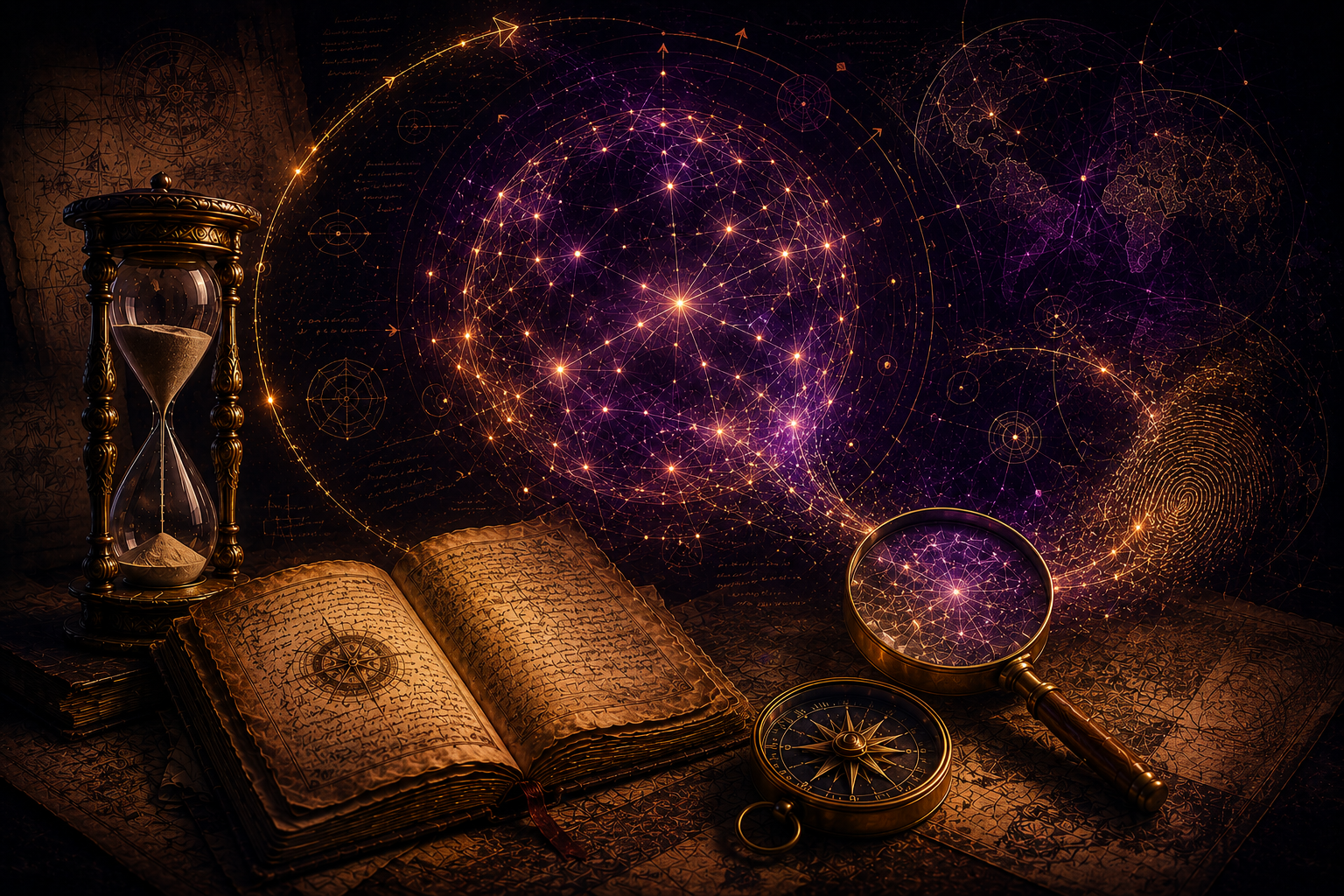
We often think of intelligence as something fixed. An objective measure that can be tested, quantified, and compared across generations. History suggests otherwise. Intelligence has never been static because humanity has never been static. Every major shift in civilization has quietly expanded what it means to be intelligent, not because intelligence itself changed, but because the problems humanity needed to solve changed. When knowledge was scarce, intelligence meant remembering. Those who could retain medicine, mathematics, philosophy, or history became society's experts because information itself was difficult to access. As the Information Age emerged, memory became less valuable than reasoning. Search engines gave everyone access to knowledge, shifting the competitive advantage from knowing to thinking. Then organizations became increasingly interconnected, and another realization emerged. Some of the most successful leaders weren't necessarily those with the highest IQ, but those who could understand people. Emotional Intelligence expanded our definition once again, recognizing empathy, relationships, and self-awareness as forms of intelligence that cognitive ability alone could never explain. Looking back, none of these definitions replaced the previous one. They expanded it. Every era simply rewarded the kind of intelligence that humanity needed most at that moment in time.
Think about the evolution of medicine. A physician centuries ago earned their reputation by remembering symptoms, treatments, and anatomy because knowledge lived primarily in books and in memory. Today, nearly every physician has instant access to medical journals, diagnostic tools, and increasingly, AI-assisted recommendations. What differentiates exceptional physicians is no longer simply what they know. It is how they interpret information, communicate uncertainty, understand the patient sitting in front of them, and make decisions in context. The definition of intelligence evolved because the world around it evolved.
Artificial Intelligence Changed the Economics of Intelligence
Artificial Intelligence represents another turning point, but perhaps not for the reason we think. Much of the conversation focuses on what AI can do: write, code, analyze, translate, summarize, or create. Those capabilities are remarkable, but they aren't the real transformation. The deeper shift is economic. For centuries, intelligence was scarce. Organizations competed for experts because expertise itself was limited. Universities became repositories of knowledge, and entire industries were built around access to specialized thinking. Artificial Intelligence changes that scarcity. Capabilities that once required years of education can now be accessed in seconds. Writing is no longer scarce. Analysis is no longer scarce. Coding is becoming less scarce. Intelligence itself is becoming increasingly abundant. History shows that whenever something becomes abundant, its value changes. Electricity changed the value of physical labor. The internet changed the value of information. Artificial Intelligence is changing the value of intelligence itself. That forces us to ask a different question. Not How intelligent is AI? but What kind of intelligence becomes valuable when intelligence itself is abundant?
A founder can build a financial model without hiring an analyst. A student can summarize an entire research paper in seconds. A junior engineer can generate working code before writing a single function from scratch. The competitive advantage is no longer access to intelligence. Increasingly, it is knowing how to apply intelligence in the right context.
The Cultural Intelligence Loop
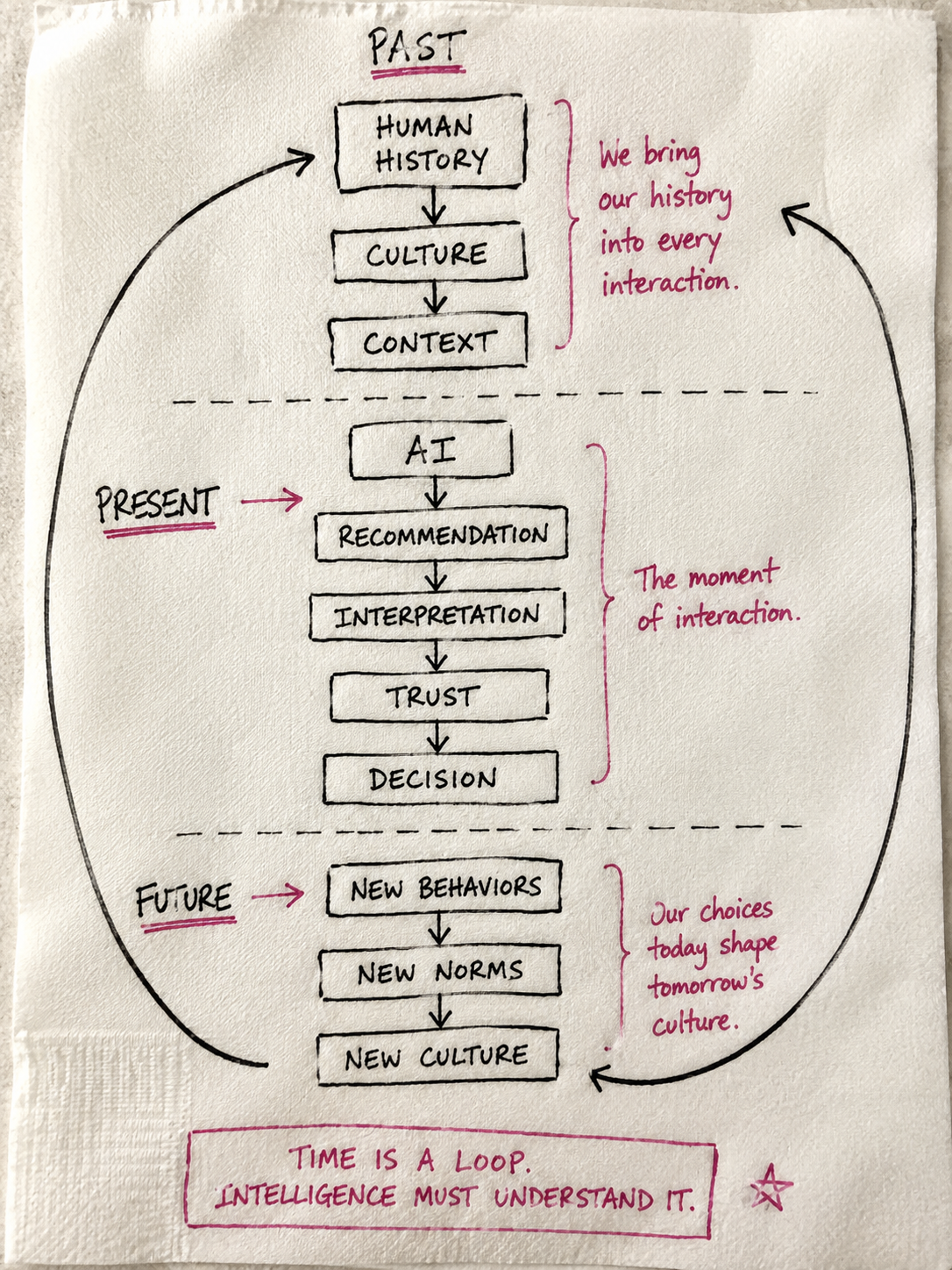
How human history shapes AI interactions, and how today's AI decisions shape tomorrow's culture.
Intelligence Doesn't Exist in Isolation
Artificial Intelligence is remarkably good at solving problems. It can identify patterns across billions of data points, summarize complex documents, generate software, recommend products, and increasingly reason through problems that once required human expertise. Yet something interesting happens when those same systems leave the laboratory and enter the real world. The technology often works exactly as intended, but the people don't always respond as expected.
Two customers can receive the exact same recommendation and make completely different decisions. Not because one misunderstood the recommendation, but because they interpreted it through different experiences, expectations, beliefs, and values. The intelligence behind the recommendation hasn't changed. The person interpreting it has.
Perhaps intelligence has never been solely about producing the right answer. Perhaps it has always been about understanding what that answer means to the person receiving it. If two people can experience the same recommendation in completely different ways, then intelligence cannot exist in isolation. It must exist within the context of the human being it is trying to serve.
A Recommendation Is Never Just a Recommendation
An AI assistant recommends a single product after evaluating hundreds of alternatives. For one customer, the recommendation feels incredibly efficient. The AI has removed unnecessary friction and simplified the decision. For another customer, the exact same recommendation feels incomplete. Shopping has never been about finding the fastest answer. Comparing alternatives, discussing purchases with family, or negotiating value is part of how confidence is built. The recommendation didn't remove work. It removed part of the decision-making process.
Healthcare tells a similar story. Imagine an AI assistant recommending a treatment plan. One patient values the directness and immediately feels reassured. Another hesitates because important medical decisions have always involved family members or physicians before action is taken. Again, the recommendation hasn't changed. The technology hasn't changed. Only the interpretation has.
These examples aren't isolated edge cases. They appear repeatedly across commerce, healthcare, finance, education, and leadership. The products change. The technology changes. The people change. Yet the underlying pattern remains remarkably consistent. The same intelligence can create trust in one context and uncertainty in another.
That realization changed the question I was asking. I stopped wondering whether AI understood people. I started wondering whether it understood the worlds people came from.
“Culture Is Time Made Visible”
We've Been Solving the Wrong Problem
When AI behaves differently across markets, our instinct is often to localize. We translate languages, adjust currencies, comply with regional regulations, and modify visual design. These are important steps, but they assume culture is something we adapt after the product has already been built. I believe the opposite. Culture isn't a layer we add at the end. It shapes how people define expertise, authority, confidence, fairness, privacy, and trust long before they ever interact with a product. Those expectations influence how every recommendation is interpreted, whether that recommendation comes from another person or from Artificial Intelligence itself.
This is why two customers can receive the exact same answer and walk away with completely different experiences. The difference isn't in the intelligence behind the recommendation. It is in the invisible context through which that recommendation is interpreted. If we continue treating culture as a localization problem, we'll continue solving the wrong problem. The challenge isn't helping AI speak more languages. The challenge is helping AI understand the worlds those languages represent.
The Next Evolution of Intelligence
The more I reflected on these patterns, the more I realized we were missing an entirely different dimension of intelligence. For decades, we have measured intelligence by how effectively someone solves problems. Later, we expanded that definition to include understanding people through Emotional Intelligence. Both remain essential, yet the AI era is revealing another question that neither fully answers. Can we understand the world another person comes from before we attempt to help them?
I believe that is the next evolution of intelligence. I call it Cultural Intelligence. Cultural Intelligence is the ability to recognize that every recommendation, conversation, and decision is interpreted through inherited human context shaped over time. It isn't about memorizing customs, holidays, or etiquette, nor is it about translating interfaces into different languages. It is about understanding the invisible forces that shape trust before a single word is exchanged.
Artificial Intelligence gives us the ability to scale knowledge. Cultural Intelligence determines whether that knowledge earns trust. One without the other may create capable systems. Together, they create systems that people are willing to believe, adopt, and ultimately integrate into their lives.
Looking Forward by Looking Back
Artificial Intelligence is trained on humanity's past. Every person it serves has also been shaped by their own past. Every interaction between AI and a human is, in many ways, a conversation between two histories. The decisions we make today won't simply improve products. They will influence behaviors. Those behaviors will become expectations. Those expectations will become culture. One day, that culture will become part of the history the next generation of AI learns from.
Perhaps that is why intelligence has never stood still. Every generation inherits a different world, asks different questions, and expands the definition of intelligence once again. I believe the AI era is asking us to do the same. Not by making Artificial Intelligence infinitely smarter, but by ensuring it understands the humanity it was built to serve.
The next generation of AI won't be defined by how much it knows. It will be defined by how deeply it understands the humanity it serves. Perhaps that is the next evolution of intelligence.