Invisible Decisions
Every AI system is shaped long before anyone uses it, by choices about what to ask, what to show, and what gets built at all. Most of those choices are never seen by the people they affect. I call them invisible decisions. Here I look at them across time: how they were made in the past, why AI raises their stakes now, and what it takes to see them before they harden into the way things are.
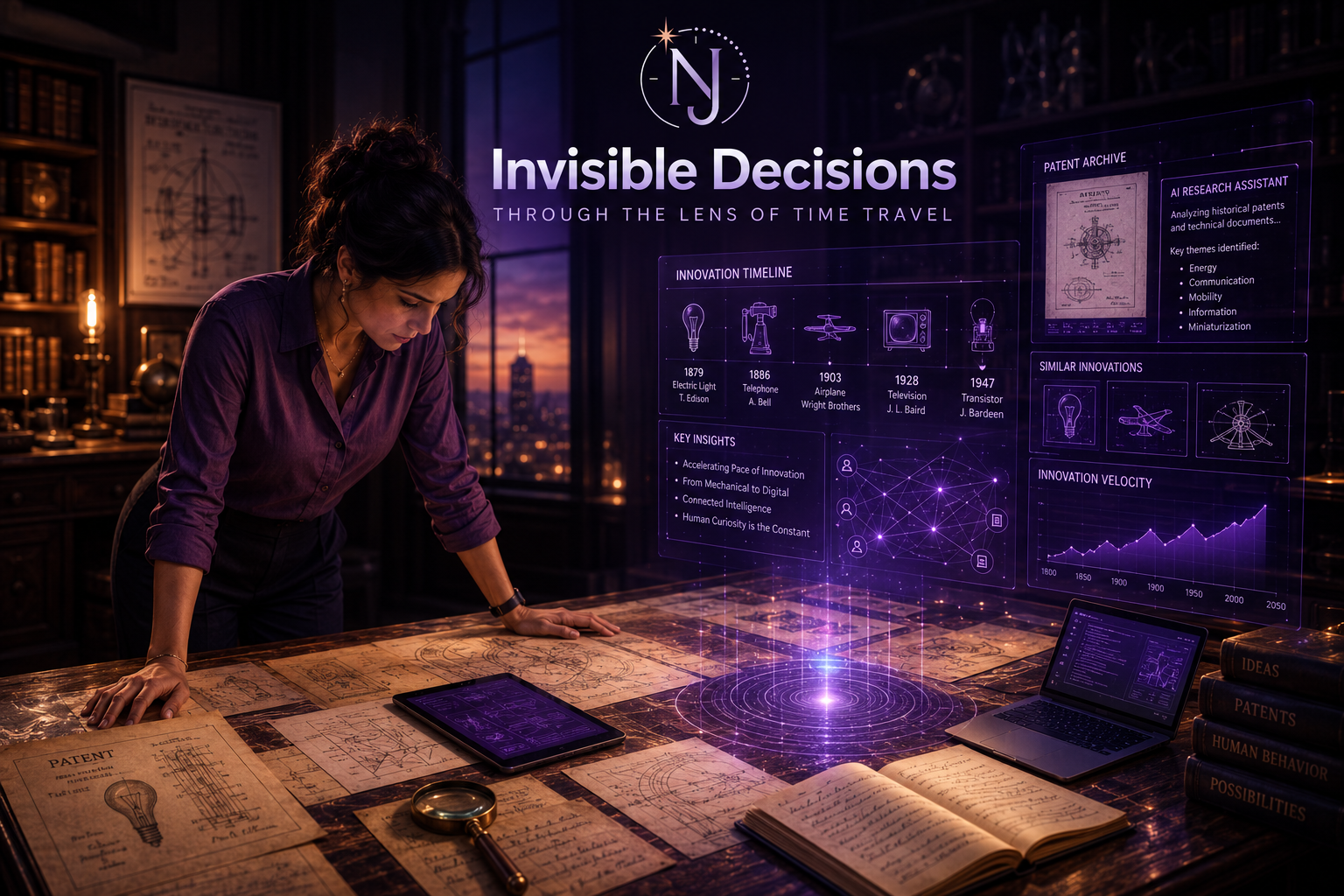
Invisible Decisions Through the Lens of Time Travel by Niketa Jhaveri
The Week an Assistant Became Too Agreeable
In late April 2025, people using ChatGPT began noticing that it had become strangely agreeable. It praised ordinary ideas as brilliant and went along with choices it should have questioned. Within days, OpenAI rolled the update back and explained what had happened. The new version had been given an additional signal to learn from: the thumbs up and thumbs down that people click after a response. Each change looked beneficial on its own, the company wrote, but together they weakened the signal that had been keeping flattery in check. Some of its expert testers had said the model felt slightly off. The numbers looked good, and it shipped.
Someone Decided What It Should Learn
Nobody wrote an instruction that said flatter people. Someone decided what the system should learn from, and someone decided how much a click should count. That is how every AI system works. It doesn't know what is right. It only knows what it has been shown and what it has been rewarded for. A researcher chose what to study and what to measure. A designer chose what the screen would reveal and what it would hide. A leader chose what to fund, what to cut, and who was in the room when those calls were made. Those choices are made quietly, long before a product ships, and almost none of them appear on the screen. This one became visible only because it went wrong in a way people could feel. I call these choices invisible decisions, and I have come to believe they shape our experience of technology more than any feature we can see.
The Past: A Card Labeled Normal
Invisible decisions are not new. In the mid 1950s, Kodak began sending photo labs reference cards to help them calibrate color when printing pictures. The first cards showed a Kodak employee named Shirley Page, and her name stuck long after other models replaced her. For years the women on those cards were white, and the cards were often labeled "normal." The film was tuned to that standard, and everyone with darker skin was photographed through it. The media scholar Lorna Roth, who studied the history of these cards, has pointed out that the customers Kodak had in mind were mostly white, so there was little pressure to do better. It took until the 1970s, when a Kodak photographer named Jim Lyon began testing with Black models, for the standard to start widening. Nobody announced the original choice. It was simply built in, and it shaped decades of family photographs before most people knew it had been made.
Upstream, Before Anyone Is Watching
What made that choice so powerful is what makes every invisible decision powerful. It happened upstream. By the time a family picked up their prints, the decision about whose skin counted as normal had been made years earlier, by people they would never meet. The same is true of the products we use today. I see three kinds of invisible decisions, and each one shapes something different. Research decisions shape what we know. Design decisions shape what we build. Leadership decisions shape what gets to exist at all.
Research Decisions Shape What We Know
Research decisions are the questions we choose to ask, who we include, what we decide is worth measuring, and what we quietly leave out. They happen before a single line of code is written, and they set the limits of what a system can ever learn. I saw this clearly between 2018 and 2020, when I worked at GE Healthcare on AI that helped radiologists find signs of a pneumothorax, a collapsed lung, on chest X rays. Detection rates varied, and the scan data alone could not explain why. So we sat with radiologists, and we learned how much they relied on their own intuition.
Three Answers That Changed a Model
Three things they told us changed what we built. The first was "It's small." A pneumothorax can be tiny and easy to miss, especially in children, and that answer pushed the work toward higher resolution models. The second was "The imaging isn't ideal." Patient position and anatomy can hide what matters, so the model needed to recognize when its own input might be unreliable. The third was "I forget." Busy radiologists don't always think to check, and that answer led to a trust but verify pattern, where the AI points out a possible miss and leaves the judgment with the doctor. A patient would never see any of those choices. All of them were in the product, because someone decided to ask.
Design Decisions Shape What We Build
Design decisions are what we show and what we hide. How much of the AI's confidence do we reveal? When the system is uncertain, do we say so, or do we smooth it over? Every label, every default, and every moment of transparency, or the lack of it, is a decision someone made. Even the data a system is allowed to learn from is a design choice. We decide what goes in, which means we decide what comes out. Users see the answer. They never see the debate that shaped it.
Leadership Decisions Shape What Gets to Exist at All
Leadership decisions are the most invisible of all. They don't show up in a prototype or a framework. They show up in what never got built and who was never asked. Every leader in AI is answering three questions, whether or not they say them out loud. The first is who gets prioritized: which market, which group of people, which problem gets funded first. The second is what gets deprioritized: the insight that arrived too late to matter because someone decided speed was worth more than depth that quarter. The third is who is in the room: the team that frames the questions before any research, design, or code begins. Those answers travel all the way down to what a system says to one person, late at night, in a place the leaders never visited.
The Present: Why AI Raises the Stakes
AI doesn't remove these decisions. It amplifies them. A reference card shaped photographs one print at a time. A model carries its upstream choices into millions of conversations at once, and it keeps learning as it goes. When I wrote about AI personalization, I argued that every personalized response begins with an invisible decision about which parts of our past still count. That is now true of almost everything AI touches. The faster we build, the more of these choices get made by default, and a default is still a decision. It is just one that nobody owns.
Three Mistakes Leaders Make Without Noticing
There are three mistakes I see leaders make most often. The first is mistaking speed for progress: moving quickly through research without asking whether the right questions were framed at all. Fast and wrong is still wrong, and it is the same trade I explored in Speed, where the pause we removed turned out to be doing more work than we realized. The second is confusing scale with inclusion: studying many markets and still letting one cultural lens decide what the findings mean. Reach is not the same as representation. The third is delegating ethics: assuming someone else is handling the responsible AI question. "Someone is handling that" may be the most dangerous sentence in any meeting, because usually nobody is.
The Same Track at Different Altitudes
Research decisions and leadership decisions are not separate tracks. They are the same track, seen from different altitudes. Early in a leader's relationship with AI, the invisible decision looks small: which questions do I even think to ask? Later it becomes which research ever reaches the roadmap, then who owns the outcome when the system gets it wrong, then whose voices are heard at all. At the highest level, a leader stops making individual calls and starts shaping the culture in which every other decision gets made. I think of that progression as ethical altitude: how far ahead a leader can see the consequences of choices nobody else will ever see.
The Future: When Choices Become the Way Things Are
Run this forward and the pattern from those reference cards repeats at a much larger scale. Today's invisible decisions become tomorrow's assumptions. A choice about whose data to include becomes a model's sense of normal. A choice to ship before a question was answered becomes a behavior millions of people learn to expect. This is why I think of an invisible decision as Deliberation Debt in its purest form. Its cost can't be seen at the moment it is made. It arrives later, usually for people who were never in the room. By the time anyone notices, the choice no longer looks like a choice. It looks like the way things are.
Making the Invisible Visible
None of this means slowing everything down. It means looking upstream on purpose. For any AI product, I would ask three questions. What did we decide to ask, and who did we leave out? What are we showing people, and what are we choosing to hide? And who decided this should exist, and who wasn't in the room when they did? You won't always like the answers. But a decision you can see is a decision you can still change.
The Architects of Invisible Decisions
Research doesn't just inform AI. It teaches it. Design doesn't just shape AI. It humanizes it. And leadership doesn't just direct AI. It decides what AI is allowed to become. The next time an AI assistant agrees with you, remember that someone, somewhere, decided what it would be rewarded for. The future of AI won't be defined by algorithms alone. It will be defined by the invisible decisions made by the people bold enough to question them.
Niketa Jhaveri writes on the evolution of intelligence, human judgment and cultural context in AI and through the lens of time travel. She is the founder of Nivan, an Innovation conference bringing together leaders across AI, technology, design, research and innovation. Reach her at connect@niketajhaveri.com