

Humanity Across Time
Four eras that reshaped how we think, create, and decide.

Every generation believes it is living through the greatest technological revolution in history. Steam engines transformed the world. Electricity extended it. Computers digitized it. The internet connected it. Today, artificial intelligence is reshaping it once again. Yet history suggests something even more profound. Technology never changes only our tools. It changes our capabilities. Those capabilities change our behaviors. Those behaviors reshape our societies. And over time, they redefine what it means to be human. If we want to understand where AI is taking us, we first need to understand the pattern that has repeated throughout history.
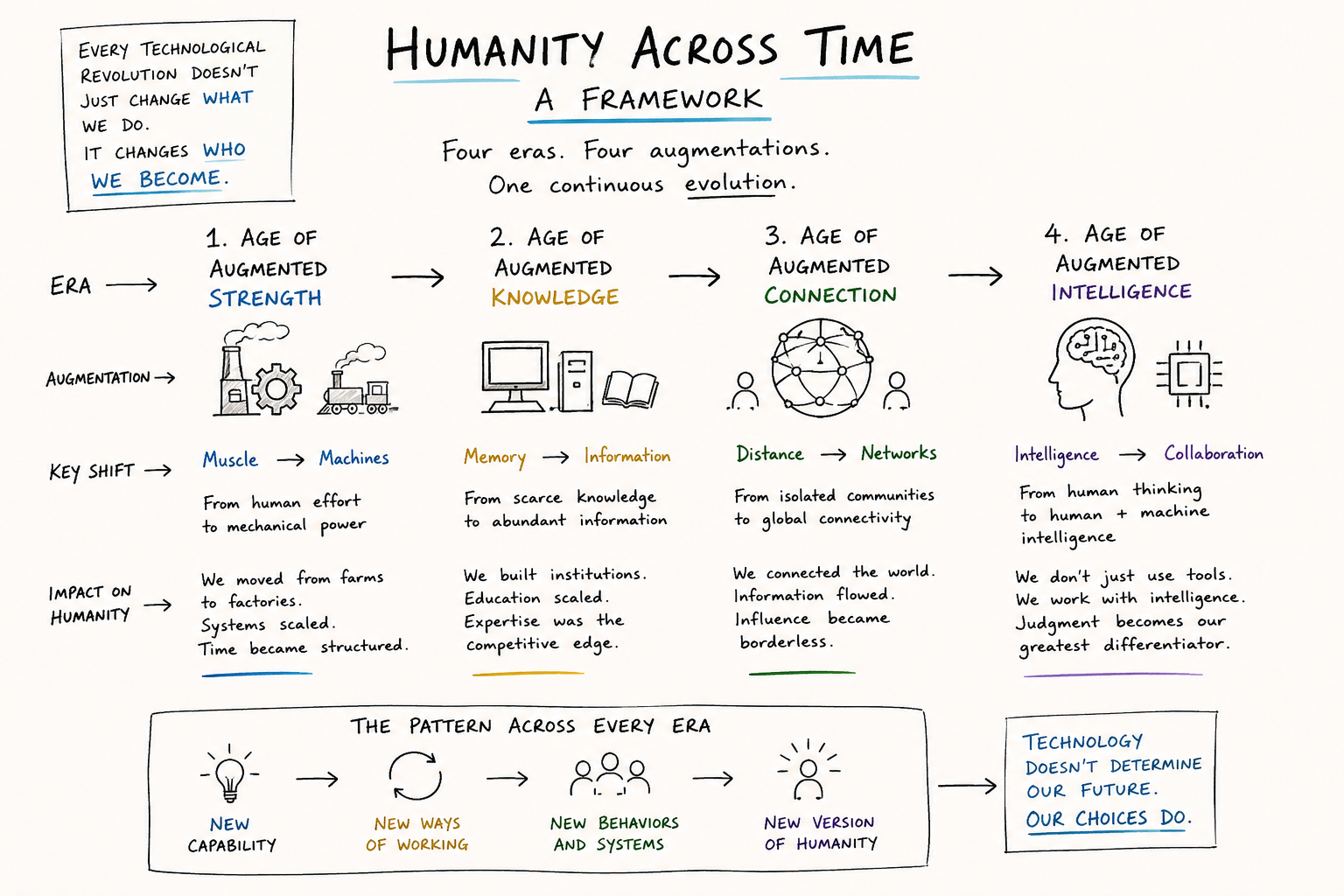
Humanity Across Time
Technology doesn't just change what we build. It changes who we become.
The Age of Augmented Strength
The first great technological revolution was not about intelligence. It was about strength. For thousands of years, civilization depended on human and animal labor. Farms, construction, manufacturing, and transportation were constrained by physical capability. The Industrial Revolution fundamentally changed that equation. Machines amplified muscle, allowing humanity to produce at a scale that had never before been possible. Productivity accelerated, cities expanded, and societies reorganized around factories instead of farms. The greatest transformation was not simply mechanical. It was cultural. Efficiency became a virtue, standardized time became essential, and systems became more powerful than individuals. Humanity had entered its first era of augmentation, where machines multiplied what our bodies could accomplish.
The Age of Augmented Knowledge
The computer introduced a different kind of revolution. Instead of extending physical capability, it extended the human mind. Information that once lived in books, filing cabinets, and memory became digital, searchable, and infinitely reproducible. Knowledge shifted from being scarce to abundant. Organizations became powered by software, education became increasingly digital, and entire industries emerged around information rather than manufacturing. The defining challenge of this era was no longer gaining access to knowledge. It was making sense of it. Humanity had learned to augment memory, calculation, and information processing at unprecedented scale.
The Age of Augmented Connection
The internet transformed another uniquely human capability: our ability to connect. Geography became less relevant as ideas, businesses, and communities crossed borders instantly. Individuals gained global audiences, organizations operated across continents, and collaboration became increasingly networked. Yet greater connection also introduced greater complexity. Information became overwhelming, algorithms influenced attention, and digital identities became extensions of ourselves. This era reminded us that connecting people is easier than helping them understand one another. Humanity had expanded its reach, but also inherited new responsibilities that came with living in an always-connected world.
The Age of Augmented Intelligence
Artificial intelligence represents a fundamentally different kind of transformation. Previous technologies extended what humans could do. AI extends how humans think. For the first time, technology actively participates in reasoning, creativity, communication, research, coding, design, and decision support. Intelligence is no longer a capability we possess alone but one we increasingly share with machines. As intelligence becomes more accessible, qualities that cannot be easily automated become more valuable than ever. Judgment. Curiosity. Empathy. Ethics. Wisdom. The future will not belong to those with the most information. It will belong to those who know how to apply intelligence with discernment.
The Pattern Across Time
Looking across these four eras reveals a remarkably consistent pattern. Every technological revolution begins by expanding a human capability. That new capability changes how we work. New ways of working reshape our behaviors, institutions, and cultures. Over time, society itself evolves into a new version of humanity. Steam amplified strength. Computers amplified knowledge. Networks amplified connection. AI amplifies intelligence. While the capability changes, the pattern does not.
Technology has never determined humanity's future. Human choices have. Every era presents us with extraordinary new capabilities. Every era asks the same question. Who will we become because of them?