

The Next Era of Intelligence
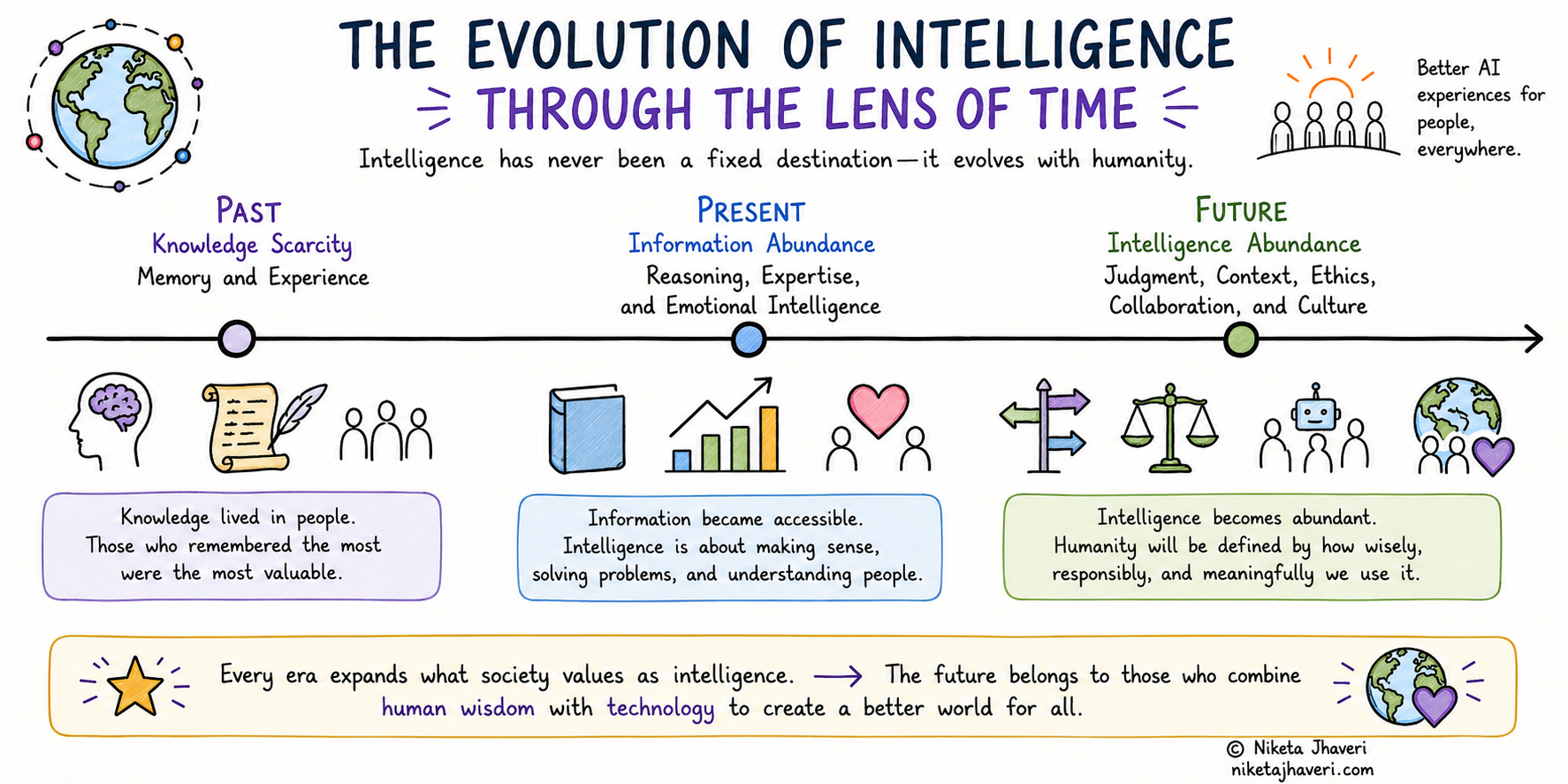
Every technological revolution changes humanity. Every change in humanity redefines intelligence.
The Next Era of Intelligence, Through the Lens of Time Travel. An hourglass, an open manuscript, a compass, and a magnifying glass rest on antique maps while a constellation of light rises above them. An essay by Niketa Jhaveri.
Intelligence Has Always Evolved
We often think of intelligence as something fixed, a quality that can be measured, ranked, and compared across generations. History suggests otherwise. Intelligence has always evolved alongside humanity because every era creates different problems, expectations, and possibilities. When knowledge was scarce, society valued memory. As information became more accessible, reasoning became more important. As organizations became increasingly connected, emotional intelligence gained prominence because success depended not only on solving problems, but also on understanding people. Each era did not replace the intelligence that came before it. It expanded what intelligence needed to include.
Artificial Intelligence Changes the Economics of Intelligence
Artificial Intelligence represents another turning point because it is making capabilities that once required specialized expertise increasingly abundant. Writing, coding, research, translation, analysis, and problem-solving can now be accessed in seconds. The most important transformation may not be that machines are becoming more intelligent, but that intelligence itself is becoming less scarce. History shows that when something becomes abundant, its value changes. The internet changed the value of information. Electricity changed the value of physical labor. Artificial Intelligence is now changing the value of cognitive capability. That raises a larger question: what forms of intelligence become most valuable when answers, ideas, and analysis are available almost instantly?
Five Dimensions of Intelligence Through the Lens of Time
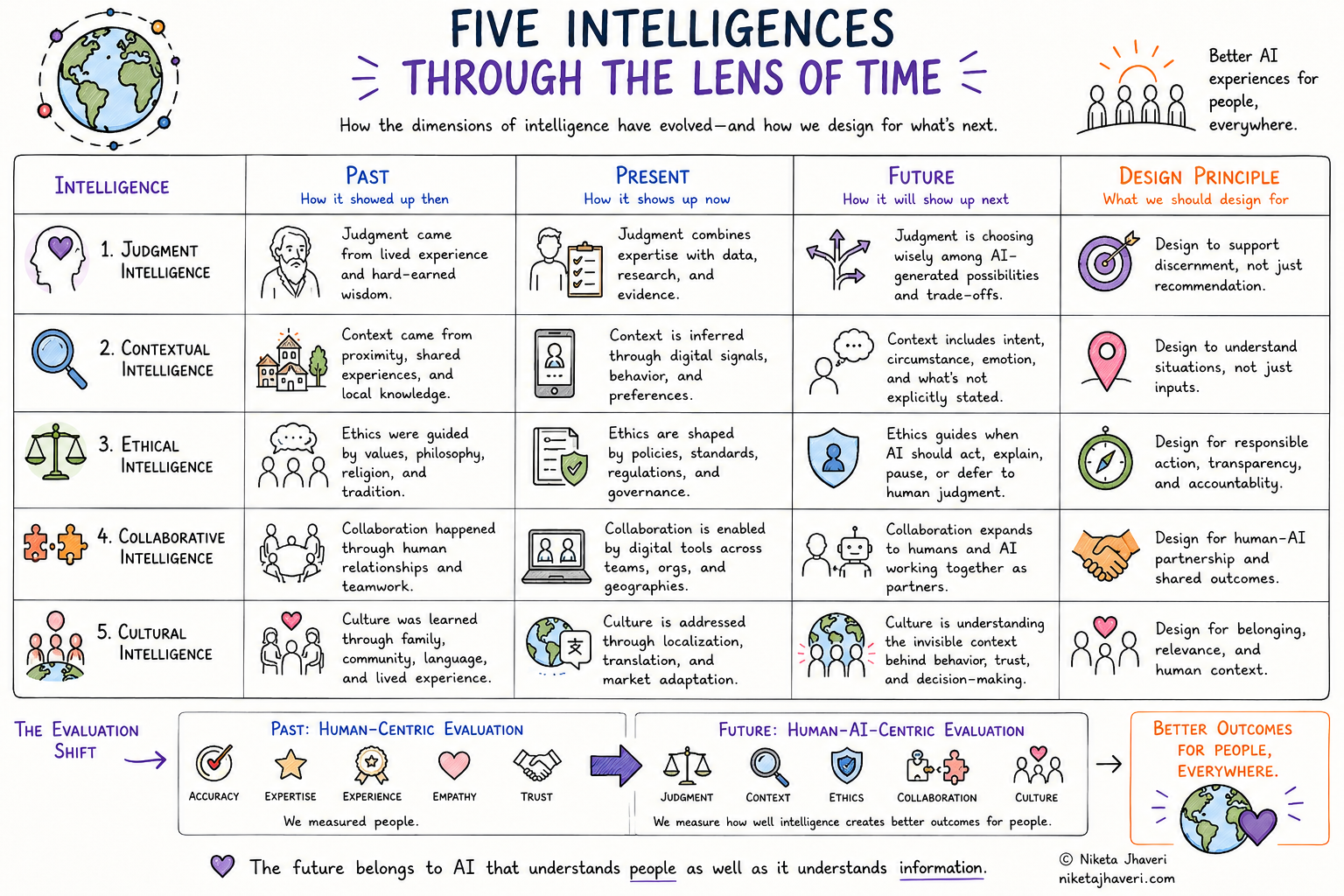
Judgment Intelligence
Judgment is the ability to move from possibility to decision. Every era has relied on it, but the source of good judgment has changed over time. What once came primarily from experience is now supported by evidence, and in the future may become essential for choosing wisely among AI-generated possibilities.
Past: Judgment Came From Experience
In the past, judgment was shaped primarily through lived experience. Physicians, craftspeople, merchants, and community elders earned trust because they had encountered similar situations over many years. Their intelligence was not simply what they knew, but what experience had taught them to notice. A physician recognized patterns across previous patients. A merchant understood when a deal felt unstable. A craftsperson knew when a material would fail before the problem became visible. Experience served as the evidence behind judgment.
Present: Judgment Combines Expertise and Evidence
Today, judgment is supported by research, data, analytics, professional standards, and digital tools. A physician combines clinical experience with diagnostic tests and medical research. A business leader uses market data alongside an understanding of customers and organizational realities. A financial advisor evaluates performance models while considering a client's risk tolerance and life circumstances. Intelligence lies not only in having access to evidence, but in interpreting what that evidence means within a specific decision.
Future: Judgment Chooses Among Intelligent Possibilities
In the future, AI may generate dozens of plausible answers, recommendations, or strategies within seconds. The differentiator will no longer be the ability to produce options. It will be the ability to recognize which option deserves confidence. A physician may receive multiple AI-generated treatment plans, but judgment will determine which one fits the patient's condition, values, and tolerance for risk. A leader may receive several viable strategies, but judgment will determine which path aligns with the organization's purpose and long-term consequences. As intelligence becomes abundant, discernment becomes more valuable.
Contextual Intelligence
Context determines whether an answer is merely correct or genuinely useful. Across time, people have understood context through proximity, data, and increasingly through signals of intent and circumstance. As systems become more capable, intelligence will depend on recognizing not only what is happening, but what it means in that specific moment.
Past: Context Came From Proximity
In the past, context was understood through physical closeness and shared experience. People knew the customs, relationships, seasons, histories, and unspoken expectations of the communities around them. A local merchant understood what families could afford and when demand would change. A physician often knew the patient's family and living conditions. A leader understood conflict through years of shared history. Context was rarely documented because it lived naturally within the community.
Present: Context Is Inferred Through Data
Today, digital systems attempt to understand context through location, browsing behavior, purchase history, preferences, device usage, and behavioral patterns. A shopping platform may recommend products based on previous purchases. A streaming service may infer a person's interests from what they watch. A customer-service system may adjust its response based on account history. These signals create useful personalization, but they often capture behavior without fully understanding the human situation behind it.
Future: Context Includes Intent and Circumstance
In the future, intelligent systems will need to understand context that people do not explicitly state. The same person may want efficiency in one moment and reassurance in another. A customer asking about a delayed package may technically need tracking information, but emotionally need acknowledgment because the package contains medication or a gift for an important occasion. A technically correct answer may still be the wrong response if it ignores urgency, uncertainty, emotion, or consequence. Contextual Intelligence will mean understanding not only what is being asked, but why it matters in that moment.
Ethical Intelligence
Every form of intelligence carries consequences. Ethical Intelligence shapes how people and systems distinguish between what is possible, what is responsible, and what should remain under human control. Its expression has evolved from shared values to formal governance and will increasingly guide how AI acts in consequential situations.
Past: Ethics Were Guided by Shared Values
In the past, ethical decisions were shaped by philosophy, religion, tradition, law, and community expectations. People relied on shared principles and human judgment to decide what was fair, responsible, or harmful. A physician balanced treatment with the duty to avoid harm. A community leader considered how a decision would affect relationships and collective stability. Ethical intelligence emerged through debate, reflection, and accountability within human institutions.
Present: Ethics Are Formalized Through Governance
Today, ethical decision-making is increasingly supported by regulations, organizational policies, review boards, professional standards, and responsible technology frameworks. Companies establish rules for privacy, data use, accessibility, safety, and bias. Governments create regulations for industries where decisions can significantly affect people's lives. These structures are necessary, but compliance alone does not guarantee ethical outcomes. A decision can follow policy while still producing harm that the policy did not anticipate.
Future: Ethics Guides What AI Should Do
In the future, AI will participate more deeply in hiring, lending, healthcare, education, insurance, public services, and other consequential decisions. Ethical Intelligence will require more than preventing obvious harm. It will involve recognizing when a system should explain itself, when uncertainty should be made visible, when automation should pause, and when human judgment must remain in control. AI may be capable of recommending an action, but ethical intelligence will determine whether that action should be taken and who should remain accountable for the outcome.
Collaborative Intelligence
Intelligence has always grown through relationships. People have learned, created, and solved problems together long before digital tools existed. As AI becomes part of the work itself, collaboration will expand beyond human teams and require a new ability to coordinate human judgment with machine capability.
Past: Collaboration Happened Between People
In the past, intelligence grew through apprenticeship, conversation, observation, and collective work. Knowledge moved from master to apprentice, from teacher to student, and from one generation to the next. People combined different skills to solve problems that no individual could solve alone. Collaboration expanded intelligence by allowing experience, creativity, and specialized knowledge to move across people.
Present: Collaboration Is Enabled by Technology
Today, digital platforms allow teams to work across disciplines, organizations, and countries. People collaborate through shared documents, communication tools, research platforms, and digital workflows. Technology accelerates coordination and makes knowledge easier to distribute. Yet the intelligence still comes primarily from people who interpret information, negotiate tradeoffs, and align around shared goals.
Future: Collaboration Expands to Humans and AI
In the future, collaboration will increasingly include intelligent systems as active participants in the work. AI may generate ideas, challenge assumptions, synthesize research, simulate outcomes, and execute parts of a process. Collaborative Intelligence will mean knowing what should be delegated to AI, what requires human ownership, and how both can improve the work together. The most capable professional may not be the person who knows the most or uses AI the fastest, but the person who can orchestrate human creativity, machine capability, and collective judgment toward a meaningful outcome.
Cultural Intelligence
Intelligence does not operate outside culture. Every answer, recommendation, and decision is interpreted through values, relationships, expectations, and histories shaped over time. Cultural Intelligence has moved from lived understanding to localization, and its next evolution will require AI to recognize the deeper human context behind behavior.
Past: Culture Was Learned Through Lived Experience
In the past, culture was understood through family, community, language, tradition, and daily life. People learned how trust was built, how authority was expressed, how decisions were made, and what behavior was considered appropriate by participating in the culture around them. These patterns were rarely written down because they were inherited through relationships and repeated over generations.
Present: Culture Is Treated as Localization
Today, global organizations often address culture through translation, currency, regulations, local products, and regional design. These adaptations are important because they make products operationally relevant across markets. However, localization often happens after the product and its underlying assumptions have already been created. A system may speak the local language while still misunderstanding how people establish trust, involve family, interpret expertise, or make decisions.
Future: Culture Becomes Part of Intelligence
In the future, AI will need to understand the invisible human context behind language and behavior. Two people may receive the same recommendation and interpret it differently because they bring different histories, values, and expectations to the interaction. One customer may value a single confident recommendation, while another may need comparison, discussion, or family involvement before feeling ready to decide. Cultural Intelligence will not mean memorizing customs or stereotypes. It will mean recognizing how time, place, relationships, and collective experience shape what people consider trustworthy, fair, and useful.
The Next Expansion of Intelligence
Looking through the lens of time reveals a pattern that repeats throughout history. Every technological revolution changes what humanity can do, and every change in human capability quietly expands what society values as intelligence. We never abandoned memory when reasoning became important, and we never replaced reasoning when emotional intelligence emerged. Instead, each era built upon the last, adding new dimensions that reflected the challenges of the world at that moment. Intelligence has never been a fixed destination. It has always evolved alongside humanity.
Artificial Intelligence represents the next turning point in that story. Its greatest impact may not be that machines are becoming more intelligent, but that capabilities once considered rare are becoming widely accessible. As writing, coding, analysis, research, and reasoning become increasingly abundant, the value of human intelligence shifts once again. The future will reward not only what we know, but how we judge, interpret, collaborate, act responsibly, and understand the people and worlds around us.
The five dimensions explored here are unlikely to be the final expansion of intelligence. History suggests there will be others, just as previous generations could not have predicted the importance of emotional intelligence before the modern workplace demanded it. Every era creates new challenges, and every challenge reveals new capabilities that society begins to value. Intelligence continues to evolve because humanity continues to evolve.
Perhaps that is the most important lesson history offers us. The question is no longer whether Artificial Intelligence will become more capable. It almost certainly will. The more important question is whether humanity is willing to expand its own understanding of intelligence once again. Through the lens of time, every generation has redefined what it means to be intelligent. I believe the AI era will ask us to do the same.