

AI Through the Lens of Time Travel
Technology changes what people can do almost overnight. Understanding what it changes about us can take generations. Drawing on twenty five years of building with the internet and AI, Niketa Jhaveri looks across time to ask what happens when machines hand us capabilities we once had to earn, and why the choices we make now will quietly become the infrastructure of tomorrow.
AI, Through the Lens of Time Travel by Niketa Jhaveri.
The Future I Entered Without Knowing
In 1999, I was studying commerce in Mumbai when I began teaching myself Photoshop, HTML, CSS, and Dreamweaver. By 2001, I was working as a junior web designer while still in college. At the time, I thought I was learning to build websites. Looking back, I was taking part in something much larger. The internet was changing who could create, who could publish, who could build a business, and who could reach the world without asking permission. It wasn't simply introducing new tools. It was redistributing capabilities that had once belonged to institutions. I didn't have the language for that then. I was too busy learning my way through it. Twenty five years later, as I watch AI unfold, I recognize a question I couldn't have put into words at the time. When technology gives people capabilities they previously had to earn, what happens to the systems, institutions, and experiences that once stood between them and those capabilities?
What History Reveals That Progress Conceals
We tend to remember technological revolutions through their inventions: the printing press, the steam engine, the computer, the internet. Yet inventions are only the visible part of the change. The printing press changed who could take part in the circulation of knowledge. Industrialization reorganized labor, expertise, and the relationship between people and their work. The internet changed who could speak, organize, create, and influence at scale. Each revolution altered who held power, what society rewarded, and which human capabilities grew more or less valuable. Those consequences were rarely obvious at the moment of invention. We measured the immediate gains while the deeper changes accumulated across generations. Technology changes capability first. Its effects on behavior, institutions, and identity arrive on a much longer clock.
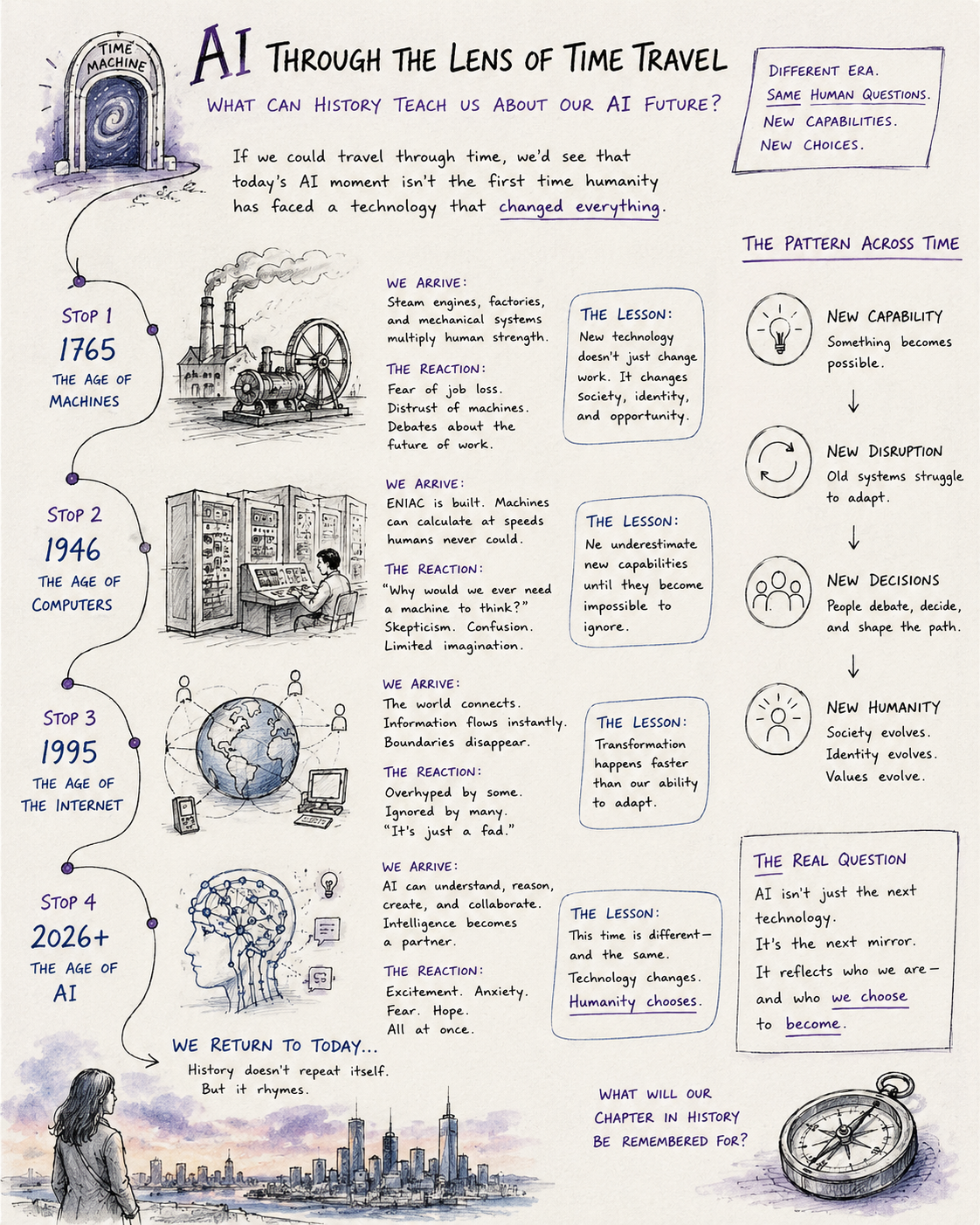
The pattern across time. New capability, new disruption, new decisions, new humanity.
A Century Old Invention Still at the Table
I felt how long that clock runs in 2003, when I joined my father's company, Delta, selling equipment to India's government railways. The railway was an invention of the industrial era, yet more than a century later it was still shaping businesses like ours and the people who built them. By then, the railway was no longer something people thought of as a technological revolution. It was simply part of how the country worked. That is why I look backward when everyone else is looking forward. History doesn't offer a prediction. It reveals the second order consequences we are prone to overlook.
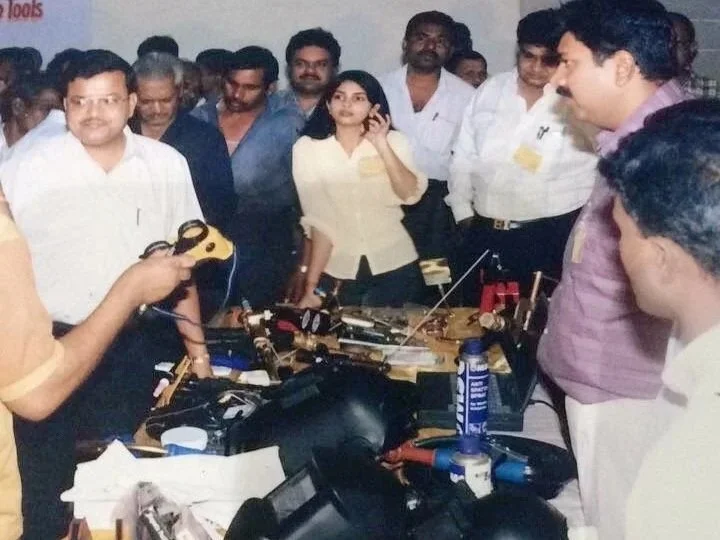
With my father at a Delta product demonstration
When the Machine Enters the Decision
Between 2018 and 2020, I worked at GE Healthcare on AI that could spot signs of a pneumothorax, a collapsed lung, on chest X rays. The computational achievement was clear: a system could recognize patterns and help prioritize cases. The more consequential question was what happened to the relationship between recognition, judgment, and responsibility. A machine could help identify what deserved attention, but the clinical meaning of that finding still depended on expertise and context. That distinction matters. Earlier technologies mostly changed the effort required to do work. AI increasingly changes where parts of the thinking happen. It can generate the analysis before we have examined the evidence, propose the decision before we have framed the problem, and produce the answer before we have developed the question. When intelligence is available on demand, the scarce thing may shift from producing answers to knowing which answers deserve our trust. So the question I carry now is how our relationship with knowledge, expertise, and accountability changes once a machine can do the task.
The Human Variables Technology Cannot Erase
Working across different markets taught me that people do not encounter technology as blank slates. They bring expectations shaped by culture, language, institutions, and everyday experiences. A system that feels helpful in one context may feel intrusive or untrustworthy in another. Even our definitions of efficiency, trust, autonomy, and intelligence are shaped by where and how we live. The technical capability may be identical. The human experience is not.
The Choices Built Into Technology
This is where I find the usual story of AI progress incomplete. We measure ever more sophisticated capabilities, yet capability alone tells us little about the human consequences of deploying them. A system can be technically correct and socially inappropriate. It can make one person more productive while weakening the conditions through which expertise develops. It can expand access to knowledge while concentrating control over the systems that organize it. Better algorithms won't necessarily resolve these tensions, because they are questions about the choices built into technology and the societies adopting it. The future will be shaped less by what technology makes possible and more by which possibilities we choose to normalize.
The Future Is a Decision We Keep Making
Looking across time has changed how I understand progress. I no longer see technological revolutions as a sequence of inventions replacing one another. I see them as recurring negotiations over human capability, agency, judgment, and power. Each generation inherits technologies shaped by decisions made before it, often without recognizing those decisions as choices.
The Infrastructure of Tomorrow
What begins as convenience becomes expectation. What becomes expectation eventually becomes infrastructure. And once something becomes infrastructure, it becomes difficult to imagine life without it. AI is accelerating that cycle because it increasingly participates in how we interpret information, make decisions, and understand the world. The more capable our technology becomes, the more consequential our choices about its role become.
What We Choose to Become
History shows how easily yesterday's decisions become today's assumptions. It also shows what lasts. AI can inherit our data, but wisdom still passes from one generation to the next through our values, our judgment, and our choices. The more AI knows, the more humans matter. So the most important question about AI is not what it will become. It is what we are choosing to become alongside it, and what we will carry forward.
Niketa Jhaveri is a UX and AI leader who examines technology and human judgment through the lens of time travel, across past, present, and future. She is the Founder and Curator of Nivan, an innovation conference bringing together leaders across AI, technology, design, and research. Reach her at connect@niketajhaveri.com