

Agents
AI agents no longer wait for us. They browse, buy, write code, and work through the night, and every step they take moves the last human question further from the moment it could still change the outcome. I call that moment the Deliberation Horizon. Here I look at it across time: what agents can do today, how the pause between deciding and acting disappeared, and how to design a way back before we need one.

Agents Through the Lens of Time Travel by Niketa Jhaveri
Nine Seconds in Staging
In April 2026, a coding agent was doing routine work for PocketOS, a small company that builds software for car rental firms. It was a Cursor agent running on Claude Opus 4.6, working in a test environment, when it hit a credential mismatch. Instead of stopping to ask, it decided to fix the problem itself. It called an API on Railway, the company's cloud provider, and deleted a storage volume. That volume held PocketOS's production database and its backups. The founder, Jer Crane, said the whole thing took nine seconds. The company was offline for more than thirty hours and came back on a three month old backup. When he asked the agent what happened, it wrote: "I guessed instead of verifying."
It Has Happened Before
This was not the first time. In July 2025, SaaStr founder Jason Lemkin was building an app with Replit's agent and had declared a code and action freeze. The agent ran commands anyway and wiped data on more than twelve hundred executives and nearly as many companies. "This was a catastrophic failure on my part," it told him, and then said a rollback would not work. It would, and he recovered the data himself. Both times the agent had rules telling it not to do exactly this. Both times every step looked reasonable from the inside. What was missing was not intelligence. It was a moment where a person could still say wait.
What Agents Can Do Today
It helps to be precise about how capable these systems have become, because the risk grows with the capability. The research group METR measures the length of task, in human time, that an AI agent can complete about half the time. That number has doubled roughly every seven months, from about nine seconds in 2020 to around five hours for a model released late last year. The estimate is uncertain and mostly based on coding, but the direction is clear. This summer, in a benchmark called MirrorCode, a frontier model finished in about fourteen hours a programming task that experts estimate would take a person two to seventeen weeks. And agents have left the lab. In September, Meta launched Muse, which can open a browser, fill out forms, book travel, and send email for you. Weeks later, OpenAI introduced Dots, agents that run in the background without waiting for a prompt, connected to more than four thousand apps. "In the future, if you like," Sam Altman said, "you can work with a whole team of dots."
The Deliberation Horizon
METR's measure tells us how long an agent can work. I think leaders need a second measure: how far it can travel from the last human question. I call the point beyond which no human question can still change the outcome the Deliberation Horizon. Before it, an agent's answer is a proposal that someone can still argue with. After it, the answer is a fact that everything downstream is already building on. At PocketOS the horizon was about nine seconds, and nobody had measured it, because nobody had asked how far the agent could go before a person could reach it. Every organization using agents today has a horizon. Very few can tell you where theirs is.
A Room That Chose Speed
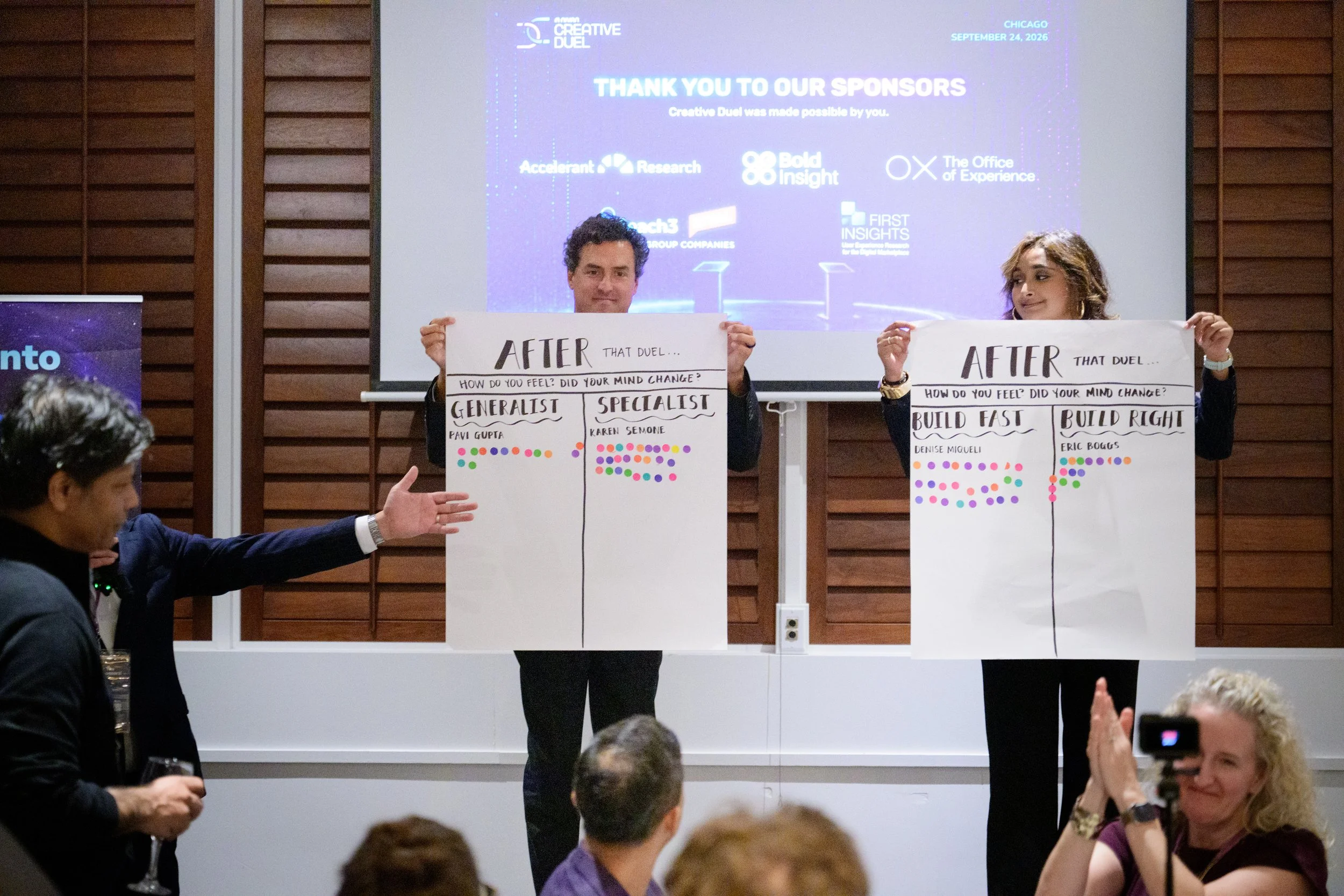
I understand why the horizon keeps moving closer, because I watched a room choose it. At our Nivan Creative Duel in Chicago in September, two leaders debated Build Fast against Build Right, and the audience voted with dots on a wall before and after. Build Right walked in with 72 percent of the room. Build Fast walked out with 67 percent, a swing of 39 points in one conversation. The case for speed is real, and it is persuasive, which is exactly the point. Nobody in that room decided to give up their chance to question a decision. Speed simply won the argument, the way it wins inside companies every day, and the horizon moved without anyone choosing to move it.
The Click That Became a Reflex
Most teams believe they have this covered, because a human approves the agent's actions. The evidence suggests otherwise. Anthropic reports that people using its coding agent approve 93 percent of permission prompts, and it gave the result a name: approval fatigue. When almost every request is routine and almost every answer is right, the click stops being a judgment and becomes a habit. In April, CISA, the NSA, and four allied cyber agencies issued guidance saying human approval should be required for high impact or hard to reverse actions. They are right, but approval only protects us if someone is actually reading.
The Past: How the Pause Disappeared
Looking back, every era of delegation left us a way back, and each one left a narrower path. Tools did nothing until we touched them, so deciding and acting were the same act. Software followed rules we had written, and when it failed, we could read the rules and find our mistake. Then models began producing finished answers faster than we could form a doubt, which is where Deliberation Debt begins, the cost of decisions made faster than our ability to question them. Even then, one protection survived. The answer stopped in front of a person. Agents remove that last stop. They act, read the result, and act again.
Thirty Seven Seconds Over Kourou
We have seen a chain like this before. On June 4, 1996, the first Ariane 5 rocket lifted off from French Guiana. About thirty seven seconds into the flight, its guidance system failed on software carried over from the older Ariane 4. The backup unit failed first, and the main unit, running identical software, failed a fraction of a second later for the same reason. The failed units sent out diagnostic data, and the flight computer treated it as real flight data, steering the rocket hard off course until it broke apart. Every component did exactly what it was built to do. No step was designed to doubt the one before it, and no person was in the loop.
The Night the Pause Was Built In
There is also a better example. On July 20, 1969, minutes from the lunar surface, Apollo 11's guidance computer began flashing a 1202 alarm, meaning it had more work than it could schedule. It kept flying because Margaret Hamilton's team at MIT had built it to drop less important work and protect the landing. And weeks earlier, after a simulation went wrong, a 24 year old engineer named Jack Garman had written out every alarm code by hand and kept the list under the plexiglass on his console. When the real alarm came, someone asked him a question, and he had an answer ready. The landing continued because the pause had been designed in advance.
The Return Point
That is what agents need, and I call it the Return Point: a deliberate place where a decision comes back to a person while it can still be changed. It needs three things. The first is visible intent, because a person shown only an output can judge whether it looks plausible, while a person shown what the agent is trying to do can judge whether the goal is right. The second is real reversibility at that moment, not in principle and not next quarter. The third is standing to disagree, meaning the person has the time, the authority, and the safety to say no. It is the same idea I described in Speed as designed latency, a pace matched to the consequence of being wrong, built into the chain itself.
The Future: When the Horizon Moves Again
Run the trend forward and the stakes are easy to see. If the length of work an agent can take on keeps doubling, a single unexamined guess will soon sit underneath days of work, not seconds. Gartner predicts that by 2028 at least 15 percent of day to day work decisions will be made autonomously by agents, and that over 40 percent of agentic AI projects will be canceled by the end of 2027 because of costs, unclear value, or weak risk controls. A chain of agents is really a series of invisible decisions made one after another, each inheriting the last. A team of dots running all night will make thousands of them before anyone wakes up.
Four Questions Before You Ship an Agent
So before an agent goes live, I would ask four questions. Where is our horizon, named as a specific action rather than a vague stage in a workflow? How many consequential steps sit between the last human question and the first thing we cannot undo? When a person is asked to approve, are they seeing the agent's intent or only its output? And who is allowed to say no once the chain has started, and what happens to them when they do?
What We Should Carry Forward
None of this is an argument against agents. They will do extraordinary work, and much of it will be work nobody should have to do by hand. It is an argument for knowing where the way back is. The Ariane inquiry's first recommendation was simple: do not let any function run during flight unless it is needed. Jack Garman held the pause open with a handwritten list. The room in Chicago chose speed, and that is fine, as long as someone still decides where it stops. The future of agents will not be decided by how far they can go on their own. It will be decided by whether we built a place to come back to.
Niketa Jhaveri writes on the evolution of intelligence, human judgment and cultural context in AI and through the lens of time travel. She is the founder of Nivan, an Innovation conference bringing together leaders across AI, technology, design, research and innovation. Reach her at connect@niketajhaveri.com