

Deliberation Debt through the Lens of Time Travel
Every compression of time has moved the bottleneck somewhere new. The press moved it from producing knowledge to judging it, the telegraph moved it from communication to coordination, and the algorithm moved it from analysis to interruption. AI moves it somewhere we have never had to defend before, which is our willingness to question an answer that has already arrived. This article develops Deliberation Debt, the compounding cost of decisions made faster than our ability to question them, and argues that the debt is created not by using AI but by the order in which we use it.

Deliberation Debt Through the Lens of Time Travel by Niketa Jhaveri
The Night the System Was Certain
Just past midnight on September 26, 1983, a Soviet lieutenant colonel named Stanislav Petrov sat watching a screen that told him the United States had launched a nuclear strike. The early warning system, code named Oko, reported one intercontinental ballistic missile and then four more behind it. The system was new, the system was fast, and the system was completely confident. Protocol was simple. Confirm the alert, pass it up the chain, and do it within minutes, because the machine had already done the thinking and his job was to move the answer forward. Petrov did something the system had no category for. He reasoned that if the Americans were truly starting a nuclear war they would not open with five missiles, and he picked up the intercom to report a system malfunction. He was right. Investigators later found that sunlight reflecting off high altitude clouds, caught at an unusual angle by satellites in Molniya orbit, had produced infrared signatures the software read as launch plumes.
What the Pause Was Actually Worth
The most valuable asset in that bunker was not detection speed. It was one person willing to spend time he did not have. The value was not in the answer. The value was in the interval between the answer and the action, and that interval is now the scarcest resource in business. What makes this moment different from every earlier compression is not that the interval has become shorter. It is that the interval has begun to feel unnecessary, because the thing arriving at the end of it is already fluent, structured and finished.
Deliberation Debt Defined
Deliberation Debt is the compounding cost of decisions made faster than our ability to question them, and the structure is borrowed from finance deliberately, because it behaves the way debt behaves. The principal is the single decision you accepted without examination, because examining it was slower than acting on it. The interest is every subsequent decision built on top of that one, and it compounds silently, because nobody logs the moment a question went unasked. The default event arrives later, usually as a strategic reversal, a product that fails in a market nobody actually studied, or a leadership team that cannot reconstruct why it believed what it believed.
Why This Is Not Simply Technical Debt
Technical debt gave engineering a vocabulary for shortcuts in code, and Deliberation Debt gives leadership a vocabulary for shortcuts in reasoning, but the two behave differently in one decisive respect. Technical debt is visible in a repository, where anyone with access can see the compromise and estimate the cost of fixing it. Deliberation Debt leaves no artifact at all. It lives in the gap between what an organization decided and what it can still explain, which means the only reliable moment of discovery is the moment someone is asked to defend the choice and finds nothing underneath it.
The Finding Almost Nobody Quoted
Researchers at the MIT Media Lab put fifty four people into three groups for a writing task, one working with no tools, one with a search engine, and one with a language model, and found that brain connectivity measured by EEG scaled down systematically with the amount of external support. The model group showed the weakest coupling, with reported reductions of up to fifty five percent in low frequency networks compared with the group working unaided, reported the lowest ownership of their own work, and often could not accurately quote what they had just produced. The researchers named the effect cognitive debt, and that much was widely reported. The fourth session was not.
Same People, Same Tool, Opposite Outcomes
Eighteen participants returned for a fourth session and switched conditions, and the results ran in both directions. Those who had leaned on the model first and then had to work unaided showed reduced alpha and beta connectivity, which is a signature of under engagement. Those who had written unaided first and only then brought the model in showed higher memory recall and stronger prefrontal activation. Nothing about the tool changed between those two groups. Only the sequence changed, and the sequence was what determined whether the person came out of the task sharper or duller.
The Order Is the Whole Argument
That single result relocates the problem, and it is the most useful thing anyone has published on this question so far. Deliberation Debt is not caused by using AI. It is caused by the order in which we use it. Human first and then AI is augmentation, because the machine is extending a position you already hold and can therefore defend. AI first and then human is where the borrowing begins, because you are no longer constructing judgment, you are evaluating a judgment that has already been constructed for you, and evaluation is a far weaker cognitive act than construction.
Position Before Prompt
The discipline that follows is short enough to carry into a meeting. Write your own answer, even badly, before you ask the system. It costs ten minutes, it requires no budget, no tooling and no permission from anyone, and it is the only intervention in this entire article that an individual can adopt this afternoon without changing how their organization works. Everything else on the list is a habit that leadership has to install. This one is a habit a person can simply choose.
What the Evidence Can and Cannot Carry
One caveat belongs here, because a concept is only as durable as the evidence beneath it. The MIT work is a single study with a small sample released as a preprint, and it is directional rather than settled. It points the same way as a much larger survey of six hundred and sixty six participants, which found a significant negative correlation between frequent AI tool use and critical thinking scores, mediated by cognitive offloading, with the strongest effect among the youngest users. Two studies do not close a question. They do tell you which way to lean while the rest of the evidence arrives, and leaning correctly early is most of what strategic advantage consists of.
The Press Did Not Persuade Anyone
Printing collapsed the cost of duplicating knowledge and it did not discriminate between good knowledge and bad. A 2024 study in Theory and Society traced witch trials across five hundred and fifty three cities in Central Europe between 1400 and 1679 and found that the publication of each new edition of the Malleus Maleficarum, the era's authoritative looking witch hunting manual, was followed by an increase in trials. The manual did not convince local authorities that witches existed. It handed them a ready made procedure that removed the need to reason from first principles, which is a far more precise description of the danger than misinformation, and a much closer analogue to what a fluent generated recommendation does inside an organization today.
The Day the Country Reset Its Clocks
When American railroads imposed standardized time zones in 1883, they did more than coordinate trains. They synchronized human decisions across a continent, so that a choice made in Chicago carried consequences in San Francisco before anyone in San Francisco had discussed it. It is also the first moment in which humans resynchronized their own relationship with time to match the pace of a machine, rather than asking the machine to match them, and every compression since has repeated that pattern without anyone treating it as a decision.
Four Million Orders, Two Hundred Twelve Customers
On the afternoon of May 6, 2010, over roughly thirty six minutes, the Dow fell 998.5 points, close to nine percent, most of it within minutes, and then recovered much of the loss. Two years later a single faulty deployment at a major market maker sent more than four million orders into the market while attempting to fill two hundred and twelve customer orders, costing the firm about four hundred and forty million dollars in forty five minutes. Nobody in either event lacked information. They lacked the ability to intervene at the speed their own systems were already operating, which is the purest illustration available of what happens when the interval closes completely.
Why AI Is Not the Fourth of Four
Each compression before this one made answers cheaper and judgment more expensive, and each generation mistook the removal of friction for the removal of risk. AI belongs in that lineage but does not sit neatly at the end of it, because the press, the clock and the algorithm all moved reasoning around faster while leaving the reasoning itself to us. This is the first compression that produces the reasoning. That is a difference in kind rather than degree, and it is why the earlier corrections, which were mostly about building better verification downstream, will not be sufficient this time.
The Balance Sheet of 2035
Run the pattern forward and the liabilities become predictable enough to name in advance. There will be strategy documents nobody can trace to a human premise. There will be teams that can produce a recommendation in an hour and cannot defend it in a meeting. And there will be convergence, where competitors reach identical conclusions because they consulted the same reasoning engine and never generated an independent alternative. The third is the quiet killer, because differentiation is a function of divergent thinking, shared cognition produces shared strategy, and an organization can survive being wrong far more easily than it can survive being indistinguishable.
Where the Debt Accumulates
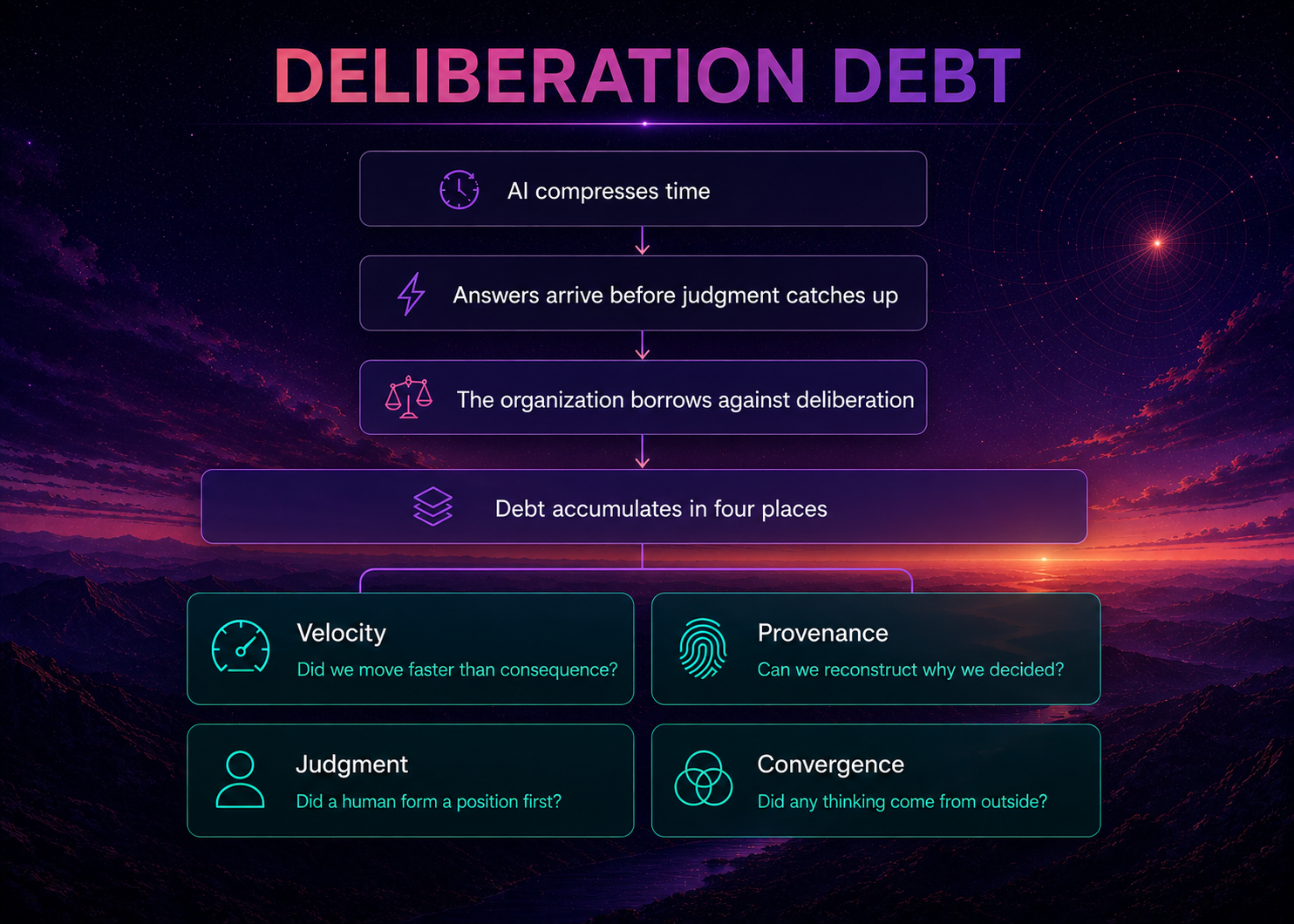
The debt collects in four distinct places, and each is best diagnosed as a question rather than a category.
Deliberation Debt Through the Lens of Time Travel by Niketa Jhaveri
The first is velocity, and the question is whether we moved faster than consequence allowed, which carries the highest interest on irreversible choices. The second is provenance, and the question is whether we can reconstruct why we decided this, which compounds at every handoff and every leadership change. The third is judgment, and the question is whether a human formed a position before asking the machine, which accrues slowly, surfaces suddenly, and is nearly impossible to detect from inside. The fourth is convergence, and the question is whether any of our thinking originated outside the model, an interest paid to competitors rather than to yourself. If you audit only one, audit provenance, because it is the cheapest to fix today and the most expensive to reconstruct later.
How the Debt Gets Repaid
Repayment is a set of habits rather than a program, and each one buys time back rather than spending it. Write your own position before you prompt. Spend the deliberation budget on one way doors, sorting decisions by reversibility before importance, because most organizations run this backwards, moving quickly on the irreversible and debating the reversible endlessly, since urgency rather than consequence is setting the pace. Log the premise and not just the outcome, in three lines: what we believed, what would change our mind, and who owns the revisit. Require a dissent the machine did not write, assigning a person rather than a prompt to argue the opposite, because convergence is a strategic risk long before it is an intellectual one. And put a date on the reversal, because a decision without a review date is not a decision. It is an assumption wearing better clothes.
The Traveler's Question
Travel to 2040, look back at the organizations that navigated this decade well, and ask what distinguished them. It will not be that they adopted AI earliest, because adoption will be universal and universal things do not differentiate, and it will not be that they had the best models, because models are a rented advantage. It will be that they retained the capacity to disagree with their own tools and built the habits to make that disagreement routine rather than heroic.
What We Should Carry Forward
Petrov had no framework. He had a few minutes, an institution that rewarded compliance, and a machine that was extremely confident and completely wrong, and what he had beyond that was the willingness to hold the interval open. We are about to give that interval away by default, one small convenience at a time, not because anyone decided to but because nobody scheduled the pause. When answers become instantaneous, judgment becomes the scarce resource. Speed is a loan. Judgment is the payment.
Niketa Jhaveri writes on the evolution of intelligence, human judgment and cultural context in AI and through the lens of time travel. She is the founder of Nivan, an Innovation conference bringing together leaders across AI, technology, design, research and innovation. Reach her at connect@niketajhaveri.com