The Becoming Gap
For most of human history, doing the work shaped who we became. The apprentice became a master by making the piece, and the developer became senior by writing the code. AI loosens that link across almost every kind of thinking work. I call the distance between what we can now produce with AI and the judgment we develop through the work The Becoming Gap. This essay looks at it across time: what doing used to build in us, what AI and agents change now, and what we will carry forward when agents carry the work.
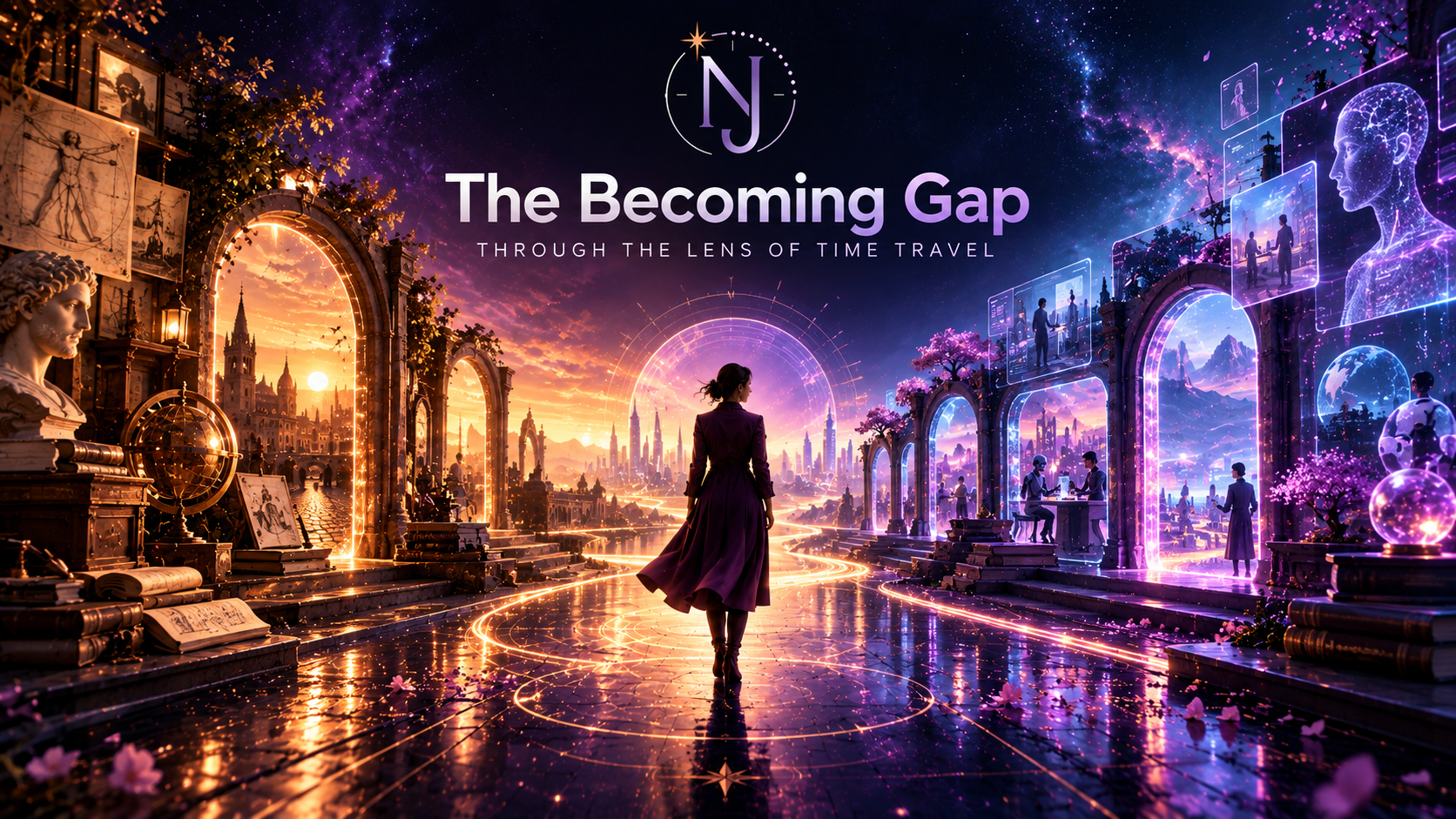
The Becoming Gap Through the Lens of Time Travel by Niketa Jhaveri
What a Masterpiece Used to Prove
With AI, almost anyone can produce something that looks like a masterpiece by tonight. So it is worth asking what a masterpiece was ever for. In the Middle Ages, it was not a great work of art. It was a test. A craftsman presented a master piece to his guild to earn the title of master, and with it the right to open a workshop and train apprentices of his own. The guild was not really judging the object. It was judging the person the object proved.
The Work Made the Worker
The work did more than prove the maker. It changed them. A 2006 study of London taxi drivers, who spend years learning the city street by street, linked more years on the job with more gray matter in the posterior hippocampus. Bus drivers, who follow fixed routes, showed no such link. It is an association, not a rule for every kind of work, but the image stays: the people who had to find their own way were changed by it.
Becoming Was Built Into the Work
Nobody scheduled that becoming. It arrived inside the work. In 1983, Lisanne Bainbridge's Ironies of Automation showed what happens when that side effect disappears. Automation leaves people responsible for the rare moments the system cannot handle, while taking away the daily practice that would have prepared them.
My Own Becoming
I know this from my own path. In 1999, while studying commerce, I taught myself Photoshop, HTML, CSS, and Dreamweaver, and by 2001 I was a junior web designer, still in college. Nobody handed me the designer I became. Every page I built made me a little more of one. Today I lead research into how people interact with AI, and I no longer build pages. Yet much of the judgment I rely on was formed by doing that work myself, making mistakes and learning why something that looked right did not work. The work changed. What it taught me stayed.
The Masterpiece Without the Journey
Earlier technologies automated parts of physical and cognitive work. Generative AI extends this to writing, coding, analysis, research, and design. The masterpiece can now be produced without the journey that once made the master. I call this The Becoming Gap: the distance between what people can produce with AI and the judgment they develop through the work. The output looks complete. What is missing is invisible, because it was never in the output. It was in the person.
The Early Evidence
In January 2026, Anthropic published a randomized trial with 52 mostly junior software engineers learning a new Python library. Those who used AI scored 50 percent on a comprehension quiz afterward, against 67 percent for those who coded by hand. They finished only about two minutes faster, a difference that was not statistically significant. It is one small experiment, not proof about learning everywhere. But in this setting, participants demonstrated substantially less learning and saved almost no time.
A Longer Clock Than Deliberation Debt
In Deliberation Debt, I explored what happens when answers arrive faster than the questions that should shape them. Deliberation Debt builds up when we skip the thinking behind individual decisions. The Becoming Gap opens when we skip the experiences that build our capacity to make those decisions at all. One changes how we decide. The other changes who becomes capable of deciding.
Exposure Is Not Experience
Agents push this further. You describe what you want, and the agent writes the code, runs the tests, and opens the change for review, so the developer moves from writing to approving. But seeing excellent work is not the same as developing the judgment to produce it. A junior engineer can approve code without understanding what made it reliable. A researcher can read a polished synthesis without ever learning to notice when what people say differs from what they mean. We may be creating a generation with unprecedented access to expertise and fewer opportunities to develop it.
Productivity Today, Expertise Tomorrow
Senior people became senior by doing junior work: fixing small bugs, reading other people's code, working through interview transcripts by hand. Much of that work is increasingly within the reach of AI agents. Stanford researchers report that employment of workers aged 22 to 25 in highly AI exposed occupations is 19 percent below where it would be had it kept pace with their less exposed peers, mostly through fewer hires. They call this descriptive, not causal. It suggests that fewer young workers are finding their way onto parts of that ladder. Organizations can now capture the productivity without necessarily developing the expertise they will need tomorrow. The gains appear on a dashboard right away. The losses appear when the people who were supposed to become experts are needed.
The Missing Human Question
Researchers have begun examining related problems through concepts such as the apprenticeship void and the apprenticeship externality. These perspectives examine how AI changes entry level work, learning opportunities, and the future supply of expertise. The Becoming Gap approaches the same transformation through a question about human development: not only what work disappears, but who that work would have helped us become.
What People Carry Forward
Agents carry the codebase, the ticket history, and the context of the last thousand decisions, and all of it stays in the system. What leaves with a person is only what they became: judgment, taste, the instinct that something is wrong before any test says so. Judgment moves between generations through work done side by side, as it did between master and journeyman. A generation that skips the becoming has less to pass on, and that cost arrives years after the decisions that caused it.
The Gap Is Not Inevitable
Socrates warned that writing would weaken memory, and each tool since has moved the becoming rather than ended it. AI does not have to widen the gap. Used deliberately, it can help close it. In the Anthropic trial, participants who asked the AI to explain its code, or asked only conceptual questions, kept much more of their learning. Not all friction is worth keeping, either. Formatting slides builds little judgment. The task is to tell friction that only slows production from friction that develops people, and to design new paths to judgment where the old ones are gone.
Three Questions Across Time
For any organization introducing AI agents, I would ask three questions. Looking back, what capabilities did people develop by doing this work themselves? Looking at today, if AI now does that work, where are those capabilities being built? Looking ahead, when the system fails, who will have the judgment to recognize it, step in, and teach the next generation? The test underneath all three is the difference between performance with assistance and capability without it.
Still Making Masters
I often say that the more AI knows, the more humans matter. The Becoming Gap is the condition on that sentence. For generations, the friction of doing the work was quietly doing the work of making us. AI can now remove that friction and carry the work forward without asking anyone to travel the same path. That is an extraordinary achievement, and a responsibility. We can design a future in which people produce more while becoming less, or one in which AI expands what people can do while creating new opportunities to develop who they become. The masterpiece is no longer proof of the master. What matters now is whether we are still making masters.
Niketa Jhaveri writes on the evolution of intelligence, human judgment and cultural context in AI and through the lens of time travel. She is the founder of Nivan, an Innovation conference bringing together leaders across AI, technology, design, research and innovation. Reach her at connect@niketajhaveri.com