

AI Personalization Through the Lens of Time Travel
Why the next frontier of AI isn’t understanding who you are. It’s understanding who you’re becoming

The Personalization Paradox
Personalization has long been one of AI’s defining capabilities. We expect AI to remember our preferences, anticipate our needs, and make every interaction feel increasingly relevant. For years, success has been measured by one question: How well does AI know me?
That question made sense when personalization was primarily about predicting preferences or recommending content. But generative AI has fundamentally changed the role of personalization. AI is no longer deciding only what information we see. It is helping us make decisions, solve problems, learn new skills, and navigate increasingly complex aspects of our lives. Every interaction has the potential to influence not only what we consume, but also what we believe, what we prioritize, and ultimately who we become.
This changes the problem entirely. The future of personalization is no longer about building a better memory of the user. It is about understanding how people evolve over time.
Every Personalized Experience Is a Journey Through Time
Every personalized response begins with an invisible decision. Before an AI generates an answer, it quietly determines which parts of our history remain relevant, which signals from our present deserve attention, and how much our future goals should influence its response. Although these decisions happen in milliseconds, they shape every recommendation, explanation, and conversation we have with AI.
Seen through this lens, personalization is fundamentally a temporal problem rather than a recommendation problem. AI is constantly navigating between our past experiences, our present circumstances, and our possible futures before producing a response. The quality of personalization therefore depends less on how much information the system has and more on how intelligently it reasons across time.
The Past Is Not One Story
One of the biggest assumptions in personalization is that our historical behavior represents a reliable blueprint for our future. Recommendation systems often treat our past as a single, continuous source of truth. Human lives are far more complex. Our history is composed of chapters rather than a single narrative. The student searching for internships eventually becomes the hiring manager. The new parent researching strollers later searches for college admissions. The beginner learning a new skill eventually teaches others. Each chapter leaves behind valuable information, but not every chapter deserves equal influence forever.
Consider someone who has spent ten years building a career as a software engineer but has recently decided to become a product manager. If an AI assistant continuously recommends engineering articles, technical tutorials, and coding communities because that is what the user’s history suggests, it is accurately reflecting the past while simultaneously slowing the transition into the future. The system has optimized for historical relevance rather than future intent. Better personalization is not remembering more about the user’s history. It is recognizing that one chapter has ended and another has begun.
Memory, whether human or artificial, is not simply storage. It is an act of selection.
The Present Is More Than Context
Most personalization systems describe the present through contextual signals such as location, language, device, or time of day. While useful, these signals capture only a fraction of what it means to understand a person in the moment. Humans move fluidly between different identities throughout the day. We may spend the morning reviewing budgets as an executive, the afternoon mentoring a colleague, and the evening planning a family vacation. Although the person has not changed, the context and intent have.
This shift is already visible in conversational AI. The same person can ask ChatGPT to review financial projections in one conversation, brainstorm birthday ideas in the next, and then explain calculus to their teenager. The assistant succeeds not because it has learned a single permanent profile of the user, but because it continuously infers which identity is active during each interaction. The future of personalization will depend less on building static user profiles and more on recognizing these dynamic shifts in identity and intent.
Understanding the present is therefore not about knowing where someone is. It is about understanding who they are in this moment.
The Future Is No Longer Predicted. It Is Influenced.
Traditional personalization optimized for prediction. If someone frequently purchased hiking gear, the system recommended more outdoor equipment. If someone regularly watched documentaries, similar content appeared in their feed. The objective was straightforward: predict the next action as accurately as possible.
Generative AI changes that relationship because it increasingly participates in decision making rather than simply responding to it. Imagine asking an AI assistant how to prepare for your first leadership role. The assistant could summarize management best practices, or it could tailor its advice around the kind of leader you aspire to become. It might recommend books that challenge your assumptions, suggest conversations you have been avoiding, or encourage behaviors outside your comfort zone. None of these recommendations simply predict what you would have done next. They actively influence what you are likely to do next.
Every recommendation increases the probability of one future while making countless alternative futures slightly less likely. AI is no longer simply predicting behavior. It is quietly participating in its creation.
The Risk of Personalizing the Wrong Self
As AI becomes more influential, a deeper question begins to emerge. Should personalization optimize for the person we have historically been, or the person we aspire to become? These two versions of ourselves are often very different.
Someone trying to improve their health has years of historical eating habits that suggest one set of recommendations, while their future goals require something entirely different. A professional changing careers wants guidance aligned with where they are going, not where they have been. An entrepreneur launching a company needs knowledge that reflects future ambitions rather than past expertise.
If AI relies too heavily on historical behavior, it risks reinforcing outdated identities. It becomes exceptionally good at reminding people who they used to be while becoming remarkably poor at helping them become who they want to become. The purpose of personalization should not be to preserve our past. It should be to accelerate our growth.
From Personalization to Temporal Alignment
If AI is constantly balancing our past, present, and future, then measuring personalization solely through relevance or engagement is no longer sufficient. A recommendation can be highly relevant to our historical behavior while being completely misaligned with the future we are intentionally trying to build.
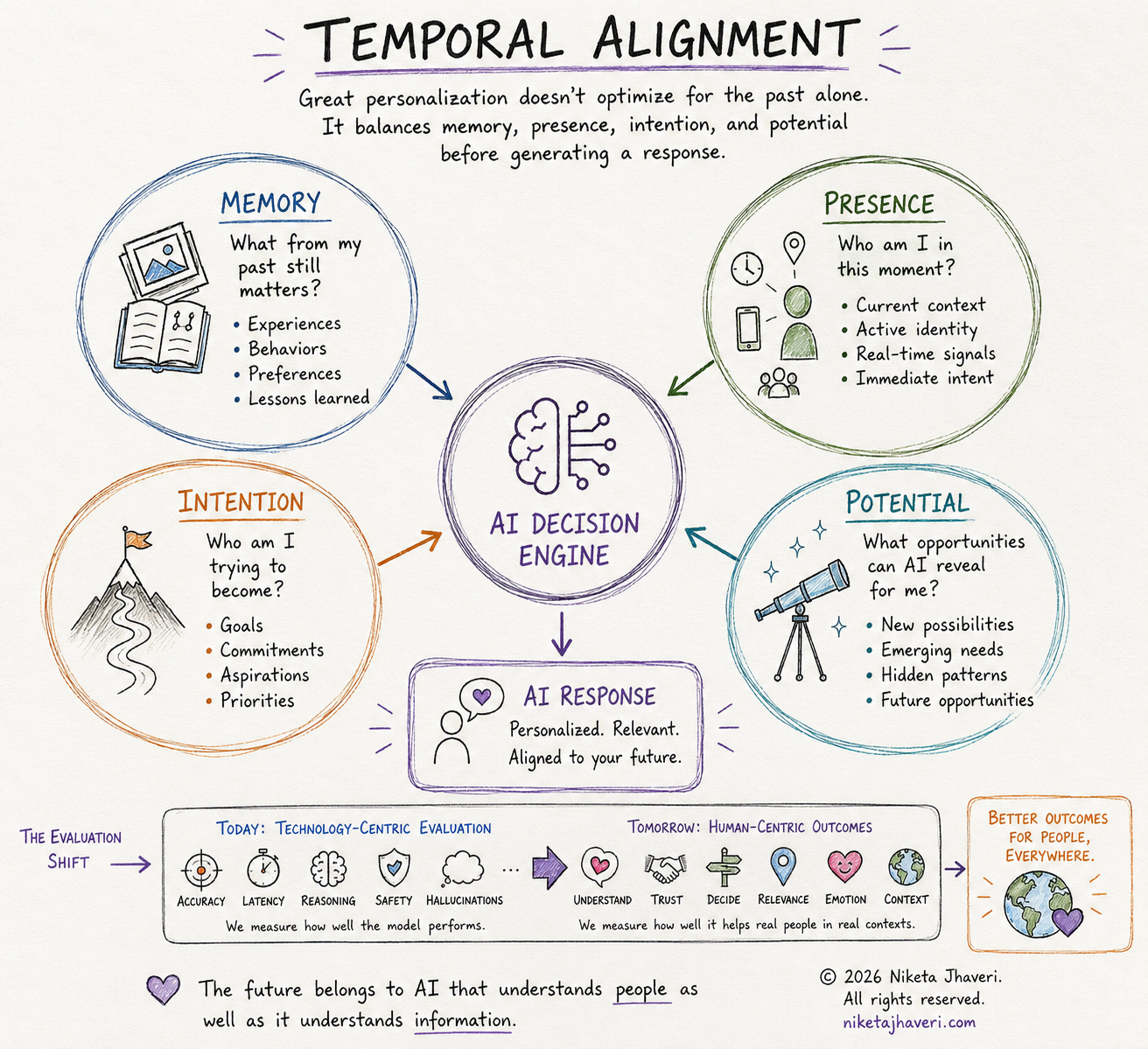
I believe personalization needs a broader framework, one that evaluates decisions across time rather than through engagement alone. I call this Temporal Alignment.
Temporal Alignment asks AI to balance four dimensions simultaneously. Memory determines which experiences from the past deserve influence. Presence understands the user’s current context and active identity. Intention recognizes the future the user has explicitly chosen. Potential considers opportunities and capabilities that neither historical behavior nor explicit goals can fully reveal.
Great personalization does not maximize any one of these dimensions. It balances them responsibly. Sometimes history should guide the decision. Sometimes present context should override it. And sometimes the future a person is trying to create deserves the loudest voice of all.
The Emergence of Temporal UX
For decades, user experience design focused on making technology easier to use. More recently, it focused on making technology more personal. I believe the next evolution will be making technology temporally intelligent.
Designing AI experiences will require us to think beyond interfaces, screens, and user journeys. We will need to design for the remembered self, the experiencing self, the aspiring self, and the future self simultaneously. Every AI interaction becomes an opportunity to balance where someone has been, where they are today, and where they hope to go.
This is more than another design principle. It represents the beginning of a new discipline that I call Temporal UX: designing AI experiences that understand people not as static profiles, but as individuals continuously evolving through time.
And Finally
Every AI system is becoming a time traveler.
Not because it can predict the future, but because every response requires it to decide which moments from our past deserve influence, which signals from our present matter most, and which future it chooses to encourage.
The defining challenge of the next decade will not be whether AI can personalize. It will be whether it personalizes wisely.
Because the greatest personalization challenge isn’t understanding who we are. It’s deciding which version of us deserves the loudest voice.
Niketa Jhaveri writes on the evolution of intelligence, human judgment and cultural context in AI and through the lens of time travel. She is the founder of Nivan, an Innovation conference bringing together leaders across AI, technology, design, research and innovation. Reach her at connect@niketajhaveri.com