

Cultural Intelligence
What should AI learn from the past, understand today, and prepare for tomorrow… across cultures?
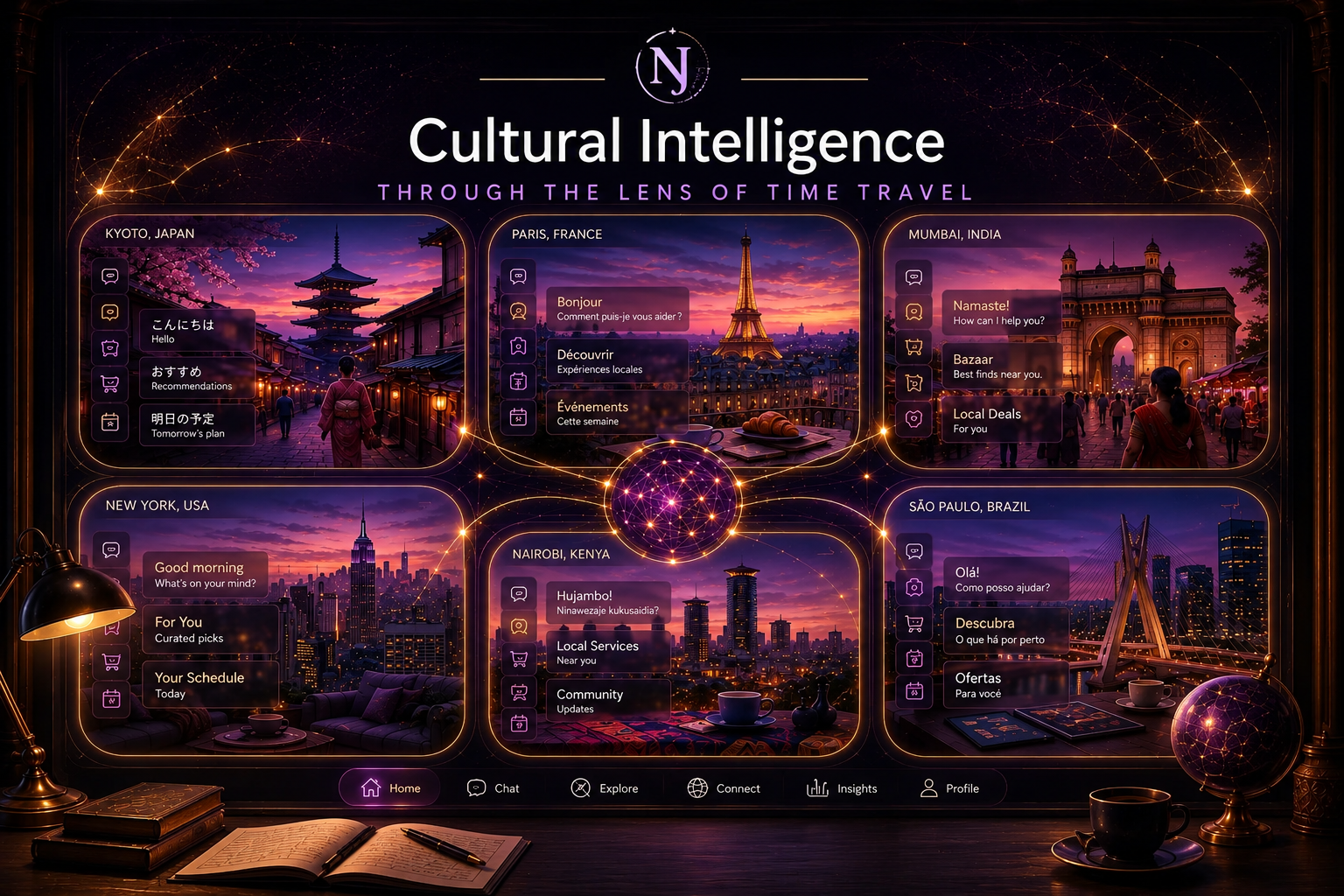
One AI. Multiple ways of thinking.
Cultural Intelligence Through the Lens of Time Travel by Niketa Jhaveri
We Are Optimizing the Wrong Thing
Every few months, a new AI model sets another benchmark. We celebrate improvements in reasoning, larger context windows, lower hallucination rates, and faster response times. These advances are remarkable, but they all measure one thing, which is how well the model performs. Customers never experience benchmark scores. They experience conversations. A response can be technically correct and still miss the mark because it assumes the wrong context, feels unnatural, or leaves someone uncertain about what to do next. As AI becomes a global product, success will depend on something far more human than intelligence alone. It will depend on understanding people.
The Term Already Exists, and It Was Built for People
Cultural Intelligence is not a new idea. It was introduced in 2003 by Christopher Earley and Soon Ang, who defined it as a person's capability to function effectively across cultures, measured across cognitive, metacognitive, motivational, and behavioral dimensions. Two decades of research have followed, along with validated assessments used by researchers and organizations around the world. That work is about human capability. It asks how well a person adapts when they enter an unfamiliar culture.
The Question I Am Asking Is the Reverse
My interest is not in whether a person can adapt across cultures. It is in whether a system can. When millions of people in dozens of markets speak to the same model, the burden of adaptation shifts. It no longer sits with the traveler entering a new place. It sits with the system that meets everyone, everywhere, at once. Applying Cultural Intelligence to systems rather than to people changes what has to be measured, what has to be designed, and what failure looks like. That shift is what this essay is about.
Technology Evolves and People Evolve With It
One of the most valuable lessons history teaches is that technology never changes in isolation. Every major technological shift has transformed human behavior alongside it. The Industrial Revolution reshaped the way we worked. The Internet redefined how we connected, learned, and shared information. Artificial intelligence is now changing how we search, decide, create, and solve problems. If people evolve with technology, then AI must evolve with people. That is why it is useful to think about AI through the lens of time rather than through the lens of technology alone.
Looking Beyond Localization
When people hear the phrase Cultural Intelligence in a product context, they often think about translation, localization, or adapting an interface for a different country. Those are part of the story but not the whole of it. What matters is whether a system understands how people communicate, build trust, make decisions, interpret information, and interact with technology within their own context. That context is never fixed. It is shaped not only by geography and culture, but also by technology, society, expectations, and human behavior itself.
Looking Through the Lens of Time
Examining this through the lens of time changes the questions we ask. Instead of asking only how AI should behave today, we begin asking what we can learn from the past, what matters most in the present, and what AI should be prepared for in the future. The shift moves us away from designing AI for a single moment and toward designing systems that evolve alongside humanity. Great AI is not only responsive to today's world. It is informed by yesterday and prepared for tomorrow.
Six Dimensions Emerge
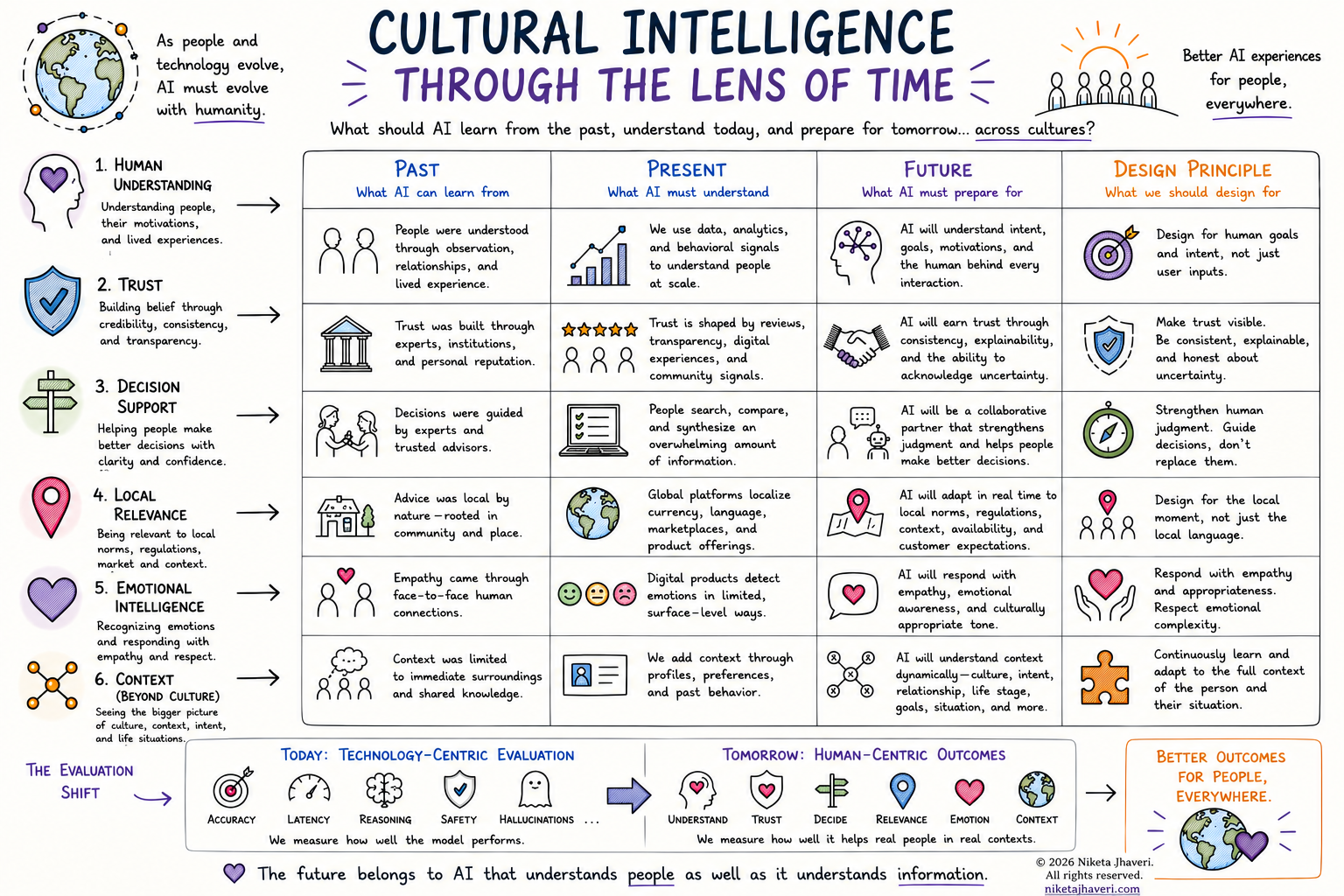
Looking through that lens reveals six dimensions that shape how people experience AI, which are Human Understanding, Trust, Decision Support, Local Relevance, Emotional Intelligence, and Context. These are not the four dimensions of the original research, because they are not measuring a person. They are measuring a system. Each has evolved throughout history, continues to evolve today, and will keep changing as technology reshapes society.
Human Understanding Is Becoming Deeper
Human Understanding has evolved from observation and lived experience to data, analytics, and behavioral signals. Tomorrow, AI will need to move beyond interpreting language and begin understanding intent, goals, motivations, and the person behind every interaction. The future of AI is not simply understanding what people say. It is understanding what they mean.
Trust Must Be Earned Again
Trust has always been one of the most important ingredients of human interaction, but the way we build it has changed dramatically. It once came from experts, institutions, and personal relationships. Today it is shaped by transparency, digital experiences, and online communities. Tomorrow, AI will need to earn trust through consistency, explainability, and the ability to communicate uncertainty rather than presenting every answer with absolute confidence.
Better Decisions, Not More Answers
Decision Support has followed a similar evolution. We once relied heavily on experts to guide important choices. Today we navigate an overwhelming amount of information ourselves. The opportunity for AI is not to replace human judgment but to strengthen it, helping people make more informed and confident decisions.
Local Relevance Is More Than Translation
Local Relevance extends far beyond translating words into another language. Advice that works perfectly in one country may feel irrelevant or even incorrect somewhere else. Future AI should understand local products, regulations, customs, holidays, payment methods, and customer expectations, so that every response feels naturally designed for the market in which it is delivered.
Emotional Intelligence Matters
As AI becomes increasingly conversational, emotional intelligence becomes equally important. Human empathy has traditionally come through relationships built face to face. Digital experiences have only begun to recognize emotional signals. The next generation of AI should respond with empathy and appropriate tone while respecting the complexity of human emotions rather than treating them as another prediction problem.
Context Connects Everything
The most important dimension is Context, because it ties all the others together. Context extends beyond geography or culture to include language, industry, regulations, life stage, relationships, intent, goals, and countless other factors that shape human decisions. The richer the context a system understands, the more useful, trustworthy, and natural every interaction becomes.
Measuring Human Outcomes
Today we evaluate AI using technical measures such as accuracy, reasoning, latency, safety, and hallucination rates. These metrics remain essential, but they only tell us how well a model performs. They do not tell us whether someone trusted the response, understood it, or felt confident enough to act on it. The future of AI evaluation should combine technical excellence with human understanding. Instead of asking whether the response was correct, we should also ask whether it genuinely helped a person in their specific context.
Turning Research Into AI Behavior
Organizations have spent decades conducting customer interviews, usability studies, ethnographic research, surveys, diary studies, and market research. Too often those insights remain trapped inside presentations after the project ends. They should instead become a living knowledge hub that continuously informs how AI is evaluated, refined, and improved. Every validated customer insight becomes another signal that helps AI understand people rather than information alone. Research should no longer end with a report. It should become part of how AI learns.
The Next Frontier
The next generation of AI will not be defined solely by larger models or higher benchmark scores. It will be defined by systems that understand people as well as they understand information. Organizations that lead will combine technical intelligence with behavioral science, UX research, and cultural understanding to create experiences that feel trustworthy, locally relevant, emotionally appropriate, and genuinely helpful.
What Comes Next
We have spent years teaching AI to understand language. The next challenge is teaching AI to understand people.
Niketa Jhaveri writes on the evolution of intelligence, human judgment and cultural context in AI and through the lens of time travel. She is the founder of Nivan, an Innovation conference bringing together leaders across AI, technology, design, research and innovation. Reach her at connect@niketajhaveri.com