

April 2026
Accelerating AI Innovation
The Transformative Power of Research
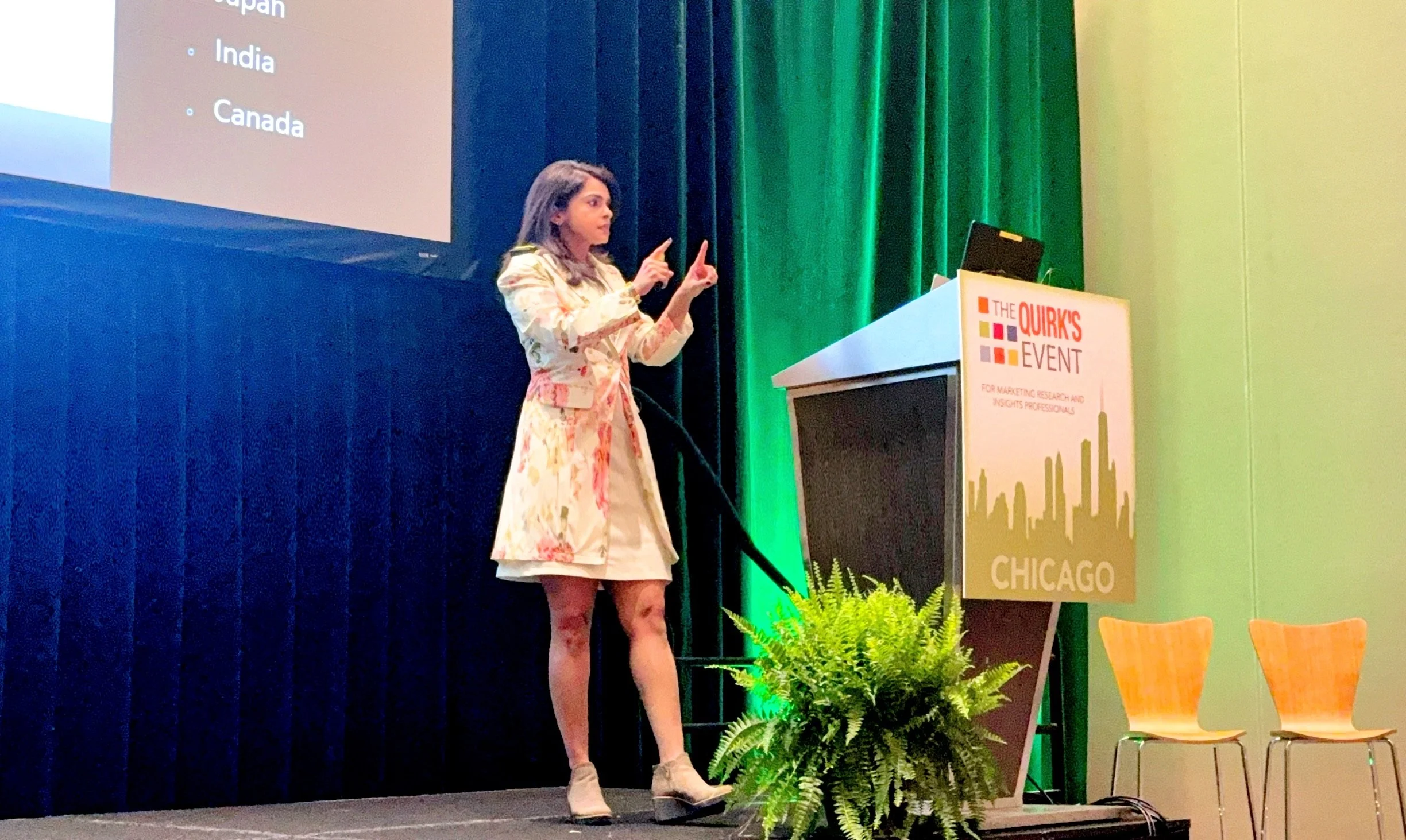
Presented at Quirks Events April 2026, this talk showed how AI transformed global UX research at Amazon, using the Rufus assistant across multiple international markets as the working example. It covered the real constraints of researching at that scale, including cultural nuance, contextual meaning, and ethical boundaries, and the AI accelerated process built to work through them, which delivered 40 percent faster synthesis, 20 percent cost reduction, and twice the insights. The larger point was that AI did not replace research, it repositioned the researcher from documenting findings to orchestrating insight and shaping business direction.
Quirks Events • Chicago
Core Idea
Research did not get replaced by AI. It got repositioned. When synthesis becomes cheap and fast, the scarce thing is no longer producing insight, it is deciding what the insight means across nine different cultures and what to do about it. Your deck argues that AI collapsed the time between question and answer, and that collapse is exactly what raises the value of the researcher who can frame, interpret, and translate.
A Framework in Evolution
The Insight Value Chain: Collect, Compress, Contextualize, Commit
Collect. Gathering signal from market, user, product, and business data. AI is now better than us at breadth and volume.
Compress. Turning volume into pattern. AI is now faster than us and improving. This is where your 40 percent came from.
Contextualize. Deciding what a pattern means inside a specific culture, market, and moment. AI is confidently unreliable here. This is where the same response works in one country and fails in another.
Commit. Choosing what the organization should do, what it should stop doing, and what it should risk. This is judgment, and it does not transfer.
The framing worth putting on stage: AI took the first two links. The strategic career question for every researcher is whether they built the last two. A team that only competed on Collect and Compress is now competing with a machine. A team that owns Contextualize and Commit just got a very fast assistant.
Key Takeaways
Technology Evolves
The tools we use will continue to change, from traditional research methods to AI-assisted workflows. Progress isn’t about replacing research. It’s about expanding what’s possible.
Humanity Endures
Needs, behaviors, trust, curiosity, and judgment remain at the heart of every successful product. Understanding people continues to be the foundation of meaningful innovation.
Research Is the Bridge
The organizations that build AI responsibly combine technological capability with deep human insight, transforming research from a checkpoint into a strategic advantage.
Key Insights
Localization is not translation. Your global challenge slide and your local challenge slide are actually the same problem viewed at two altitudes. Language and contextual meaning is a cultural intelligence problem wearing a linguistics costume.
Standardization is what makes global comparison possible and what makes local truth disappear. Your framework matrix with high, medium, and low rankings across eight markets is a deliberate trade. You bought comparability and paid in nuance. Naming that trade openly is more credible than pretending it was solved.
Unclear mental models are the hardest local challenge because users cannot describe an assistant they have never had a category for. Behavior data helps. Stated preference does not.
AI compressed synthesis, so the bottleneck moved upstream to problem framing. A badly framed question now produces a wrong answer at twice the speed and at scale.
Trust appears twice in your maturity ladder, as trust builder and trust enabler. That is the signal that the evolving role is less about analysis and more about being the person the organization believes.